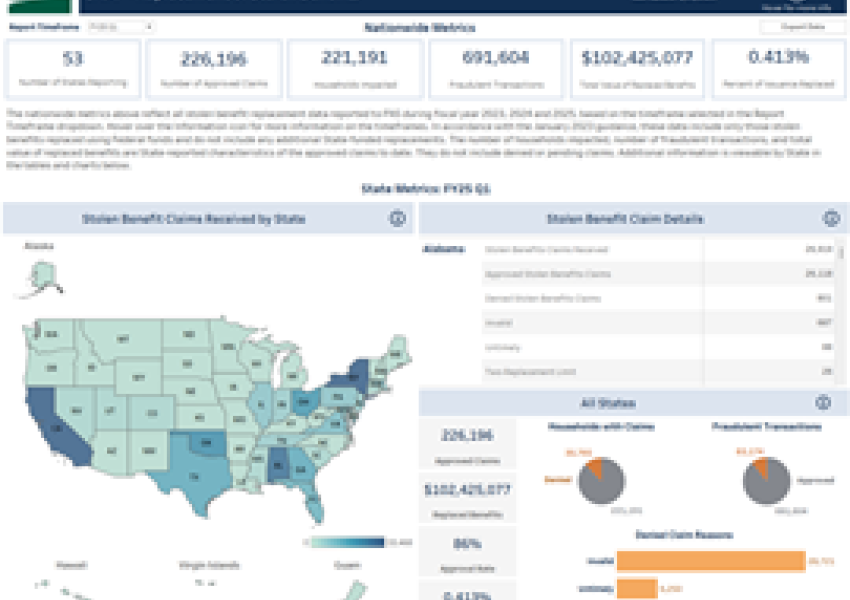
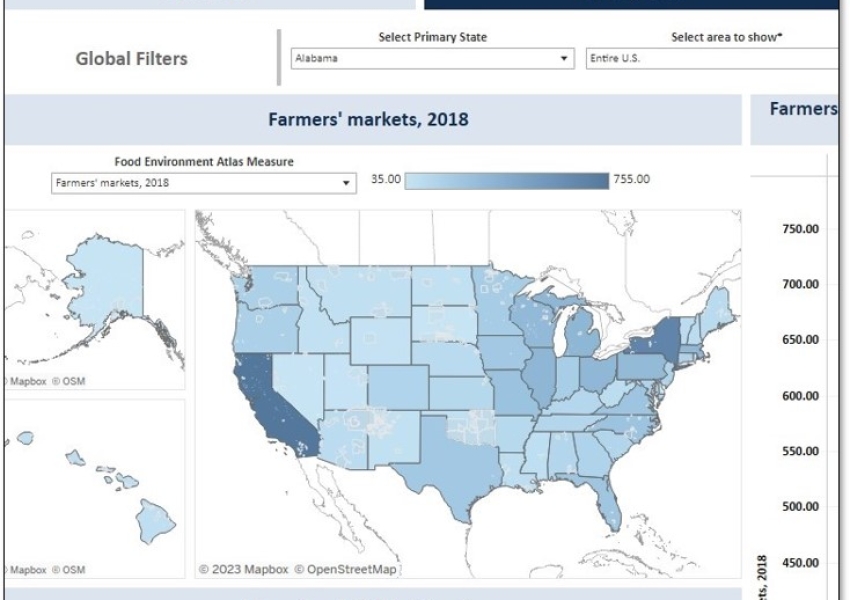
Data Visualization

FNS regularly conducts research and data analysis to inform program or policy decisions and understand nutrition program outcomes. In addition, FNS seeks to make data accessible to state and local agencies, service providers, and the public by developing data visualization and analytics tools that can be used to support nutrition program delivery or report on outcomes.

The below data visualization and analytics products bring together FNS, USDA, and other federal datasets to answer questions related to food security, nutrition assistance programs, and the systems that support them. Dashboards include “about” or “information” pages to answer questions about navigation, interactive functionality, data sources, and the data transformations that have been applied.

Proposed Rule - Updated Staple Food Stocking Standards for Retailers in SNAP

Summary

In response to section 765 of the Consolidated Appropriation Act of 2017 and subsequently enacted appropriations, this rule proposes to codify a new framework for determining distinct staple food varieties and accessory foods (such as snacks, desserts, and foods meant to complement or supplement meals, which do not themselves count as staple foods) for purposes of meeting the staple food requirements for retailer participation in the Supplemental Nutrition Assistance Program (SNAP). The rulemaking is necessary to implement the codified stocking requirements of the Agricultural Act of 2014, which increased the minimum number of staple food varieties and perishables SNAP retailers must carry. A summary of this notice of proposed rulemaking is posted on regulations.gov.

Request for Comments

Comments must be received by Nov. 24, 2025.

The Food and Nutrition Service (FNS), USDA, invites interested persons to submit comments on this proposed rule. Comments may be submitted by one of the following methods:

  • Federal e-Rulemaking Portal: Go to regulations.gov. Preferred method; follow the online instructions for submitting comments on docket FNS-2025-0018 or enter “RIN 0584-AF12” and click the “Search” button. Follow the instructions at this website.
  • Mail: Comments should be addressed to SNAP Retailer Policy Division, Food and Nutrition Service, USDA, 1320 Braddock Place, Alexandria, Virginia 22314.

All comments submitted in response to this rulemaking will be included in the record and will be made available to the public. Please be advised that the substance of the comments and the identity of the individuals or entities submitting the comments will be subject to public disclosure. FNS will make the comments publicly available on the internet via: regulations.gov. We encourage commenters to include supporting facts, research, and evidence in their comments. When doing so, commenters are encouraged to provide citations to the published materials referenced, including active hyperlinks. Likewise, commenters who reference materials which have not been published are encouraged to upload relevant data collection instruments, data sets, and detailed findings as a part of their comment. Providing such citations and documentation will assist us in analyzing the comments.

Supplementary Information

Background

The Agricultural Act of 2014 (2014 Farm Bill) amended the Food and Nutrition Act of 2008 (herein referred to as “the Act”) to increase the number of staple food varieties that certain SNAP authorized retail food stores must have available on a continuous basis in each of four staple food categories. The standards were increased from requiring a minimum of three (3) varieties to seven (7) varieties in each of the four (4) staple food categories and increased the number of varieties that must be perishable from one (1) variety in each of two (2) different staple food categories to one (1) variety in each of three (3) different staple food categories.

The Department promulgated regulations to implement the increased breadth of stock requirements in the final rule, “Enhancing Retailer Standards in the Supplemental Nutrition Assistance Program (SNAP)’’ (81 FR 90675), published on Dec. 15, 2016 (the “2016 final rule”). That rule also outlined what constituted a variety in all four staple food categories. However, after the regulations were finalized, section 765 of the Consolidated Appropriations Act of 2017 and provisions in subsequent appropriations acts have in effect prohibited the Department from implementing, administering, or enforcing the retailer ‘‘Breadth of Stock’’ and “Variety” provisions of the 2016 final rule until the Department makes regulatory modifications to the definition of ‘‘variety’’ that would increase the number of food items that count as acceptable staple food varieties for purposes of SNAP retailer eligibility. To meet this directive, the Department published a proposed rule, “Providing Regulatory Flexibility for Retailers in the Supplemental Nutrition Assistance Program (SNAP)” (84 FR 13555) on April 5, 2019. An overwhelming majority of the almost 9,000 comments received were opposed to the provisions as arbitrary and confusing and many argued the provisions would impact SNAP households’ access to a variety of healthy food options and make it easier for fraud-prone retailers that do not primarily sell food to enter the program. Additionally, the 2019 proposed rule did not incorporate specific criteria described in the preamble into proposed regulatory text. Supportive comments, from retail food stores and industry groups, generally advocated for more flexibility overall. For these reasons, and because of the length of time that has passed since comments were received, the Department is issuing this new proposed rule to solicit fresh comments on a new proposed framework to determine distinct staple food varieties that would be codified in regulatory text. The Department also proposes to add and codify food categories that count as accessory foods, which are generally considered snacks or dessert foods or are meant to complement or supplement meals. Accessory foods do not count towards meeting the staple food stocking or sales requirements for retailer eligibility. While the “Accessory Food Items” provision of the 2016 final rule did go into effect, the specific criteria that determined what qualifies as an accessory food were not incorporated into regulatory text but were, instead, implemented through agency guidance Retailer Policy Management Division Policy Memo 2020-05 and SNAP Accessory Foods List. USDA is now proposing to codify, with modifications, these two guidance documents. This proposed rule does not modify any other provisions or components of the 2016 final rule.

Breadth of Stock

In order to be eligible to participate in SNAP, a retail food store must meet either Criterion A (staple food stock) or Criterion B (staple food sales) requirements under SNAP regulations at 7 CFR 278.1(b)(1)(ii) and (iii), respectively. Most stores are authorized under Criterion A, which requires a minimum breadth of staple food stock in each of the four staple food categories, which are (1) meat, poultry, or fish; (2) dairy; (3) bread or cereals; and (4) vegetables or fruits. Specialty food stores, such as butcher shops or fruit and vegetable stands, are typically authorized under Criterion B, which requires that at least 50% of a store’s gross sales be for staple foods in at least one staple food category. Currently, (pursuant to the conditions of Section 765 of the 2017 appropriations language Act and the repeated conditions in subsequent appropriations language) stores authorized under Criterion A must carry at least three (3) varieties of staple foods in each of the four (4) staple food categories where at least one (1) variety in at least two (2) staple food categories is perishable. For each variety, stores must carry at least three (3) stocking units. Upon finalization of a new staple food variety framework through this rulemaking, the SNAP retailer stocking requirements in Section 3(o) of the Act would also go into effect because the conditions of the appropriations language will have been satisfied. Those stocking requirements, which have already been codified at 7 CFR 278.1(b)(1)(ii) but not enforced, would require SNAP retailers to stock seven (7) varieties of staple foods in each of the four (4) staple food categories, of which at least one (1) variety in each of three (3) different staple food categories is perishable. The requirement to carry at least three (3) stocking units for each variety, as currently implemented and codified in regulations, will remain the same. The increased number of staple food varieties required under Criterion A is non-discretionary. While this proposed rule would not make any changes to the minimum breadth of stock stores are required to carry, this part of the previously codified standards would be implemented for the first time upon publication of a final rule under this rulemaking.

Definitions of Accessory Food, Prepared Food, Retail Food Store, and Staple Food

The Department proposes to remove the discussion of accessory foods, variety, and main ingredient from the “Staple Food” definition at 7 CFR 271.2 for greater clarity. Instead of addressing all four terms in one definition, this proposed rule would add a separate definition for “Accessory Food.” The definition of main ingredient and the expanded frameworks for staple food varieties and accessory foods would be codified separately at 7 CFR 278.1(b). In line with the current Dietary Guidelines for Americans (DGA), 2020-2025, the definition of “Staple Food” at 7 CFR 271.2 would indicate that the meat, poultry, or fish staple food category would be referred to as the protein category to be inclusive of high protein plant-based food—and it will be referred to as, simply, the protein category through the remainder of this proposed rule. Similarly, the bread or cereals category would be referred to as the grains category to be inclusive of other grain-based food products—and it will be referred to as, simply, the grains category through the remainder of this proposed rule. The current definition of “Staple Food” already accounts for plant-based options for both the protein and the dairy categories. The proposed changes to streamline the definition of “Staple Food” would not result in any substantive changes to the definition or to existing staple food categories as currently defined.

To prevent inconsistency, the Department also proposes to remove the discussion of criteria A and B and prepared food from the definition of “Retail Food Store” in 7 CFR 271.2, Criterion B is currently outlined in 7 CFR 278.1(b)(iii). Criterion A would be outlined in greater detail at 7 CFR 278.1(b)(ii), and a separate definition for “Prepared Food” would be added to 7 CFR 271.2 through this proposed rulemaking.

Finally, the Department proposes to move out of the “Retail Food Store” definition, the criteria for determining which co-located businesses are evaluated as a single firm for purposes of determining retailer eligibility. Instead, the provision would be added as new subparagraph at 7 CFR 278.1(b)(8). The proposed reorganization of provisions currently included as part of the “Retail Food Store” definition would not result in any substantive regulatory changes.

Application of Criterion A

Reorganization

For purposes of greater clarity and readability, as well as to incorporate a more detailed framework for determining distinct staple food varieties when assessing SNAP retailer eligibility, the Department proposes to reorganize 7 CFR 278.1(b)(1). Specifically, this rule proposes to remove redundancy in subparagraph (A) of 7 CFR 278.1(b)(1)(i) and break up subparagraph (A) of 7 CFR 278.1(b)(1)(ii) to address, in separate subparagraphs, the staple food stocking standards and the requirement to display the required stock for sale on a continuous basis. This action does not make any substantive changes to the current regulations. While this proposed reorganization highlights the statutory increases in the required number of varieties in each staple food category, those non-discretionary standards were already codified by the 2016 final rule, though these requirements have never been enforced due to Section 765 of the 2017 Consolidated Appropriations Act and the repeated conditions in subsequent appropriations language. If this rule were to be finalized as proposed, it is the Department’s view that the requirements of this appropriations language would have been met and thus would negate the need for continuation of this appropriations language.

Staple Food Varieties

In this rulemaking, the Department is faced with balancing several competing interests, including ensuring that SNAP retailers carry a larger variety food options, that retailer food stores can easily understand the requirements, that the requirements can be operationalized in an efficient and cost-effective manner, and that the variety framework does not undercut Congress’ intent to make the stocking standards more rigorous so that unscrupulous retailers are not able to gain entry into SNAP for the sole purpose of defrauding the program (H.R. Rep No. 113-333, 2014). In a December 2018 report, SNAP: Actions Needed to Better Measure and Address Retailer Trafficking, the General Accountability Office (GAO) reiterated its 2006 finding that the minimal requirements for the amount of food that retailers must stock could allow retailers more likely to traffic SNAP benefits (i.e., referring to the illegal exchange of SNAP benefits for cash or consideration other than eligible food) into the program. It is with all these interests in mind that the Department proposes a modified framework for distinguishing food items that would count as distinct varieties. As a result, the Department believes that the new approach described below is superior to the 2016 construct precisely because it more effectively balances all the competing interests.

Specifically, the Department proposes to codify the framework for determining distinct varieties at 7 CFR 278.1(b)(1)(ii)(C). In general, this proposed rule would maintain the overall current framework but proposes two new groups of distinct varieties for operational simplification and to give more weight to traditional staple food products. The Department believes that this approach is superior to the 2016 structure because it will provide more options for retailers to meet the variety requirements under this new staple food framework than under the 2016 framework.

To date, the criteria for determining which foods count as distinct staple food varieties (different types of food within a staple food category) have existed only in agency guidance and have generally been defined based on the type of food (by each different plant or animal) or the main ingredient of the food product. For the protein and vegetables or fruits staple food categories, this generally means that different types of food—regardless of brand, packaging, flavoring, style or cut, etc.—count as one distinct variety. For example, all types of apples fall within one variety separate from all types of oranges, just as all forms of chicken fall within one variety separate from all forms of beef. For the dairy and grains categories, this generally means that different types of products—even those that have the same main ingredient—are distinct varieties. For example, yogurt is a distinct variety from cheddar cheese, even if they both have milk as the main ingredient; and bread is a distinct variety from pasta, even if they both have wheat as the main ingredient. More recently, FNS has counted plant-based dairy alternatives as distinct dairy varieties from the traditional mammal-based varieties for each different type of plant the product is made from (e.g., almond milk is a separate variety from soy milk and both are separate varieties from cow’s milk) and counted dairy products from different mammals as distinct traditional dairy varieties (e.g., cow milk is a separate variety from goat milk). For multi-ingredient food products, long-standing agency policy has determined variety and category by the main ingredient, defined as the first listed ingredient after water, stock, or broth. For example, if a can of beef stew has beef as its main ingredient, it counts as a beef variety in the protein category.

With the non-discretionary increase in the number of varieties SNAP retailers will be required to stock in each staple food category, retailer stakeholders have expressed concern with being able to meet the new standards, particularly for the dairy and the protein categories. An analysis of 121,294 SNAP-authorized small format retail food stores (which represent 64% of all SNAP-authorized small retailers, or 45% of all SNAP-authorized retailers) determined that, in terms of meeting the higher number of staple food varieties required by the 2014 Farm Bill, 81% of the small stores already stocked enough grains and 83% already stocked enough fruits and vegetables, while only 63% already stocked enough protein and only 52% already stocked enough dairy.

Staple Food Subgroups 1 and 2

In general, the more varieties that are subdivided based on main ingredient or other factors (such as dairy or meat fat content, whole or refined grains, and cheese firmness), the more difficult the system becomes to operationalize and the more costly it becomes for FNS to identify and document the distinct varieties. It can also become more confusing for retail food stores, making it difficult for them to meet the stocking standards simply because they do not understand the requirements. Currently, FNS employs a contractor to take photos of store aisles to get a sense of the overall store inventory, but not individual items or their ingredients. When retailers are at the margin of eligibility, and the availability of certain inventory is not clear or needed information is not on the front of the packaging, follow-up store visits or documentation requests are required to determine whether the store has sufficient stock. Such situations increase the time it takes for a retailer to become authorized. To make the variety criteria more straightforward and minimize the need to identify the main ingredient for basic food products, the Department proposes to establish two separate subgroups of staple food varieties.

In group 1 under 7 CFR 278.1(b)(1)(ii)(C)(1), the specific types of raw food identified, without any other ingredients, would count as separate varieties from multi-ingredient food products with the same main ingredient. The purpose of this group is to promote the stocking of basic staple food essentials needed for the home preparation of meals rather than counting such essentials as the same variety as multi-ingredient, processed foods with the same main ingredient. The Department proposes to include the following three types of food in group 1:

  • Grain-Based Flour;
  • Raw Grains; and
  • Dry Beans, Peas, or Lentils.

For example, as part of group 1, the following foods, which currently count as just one variety, would be separate varieties under the proposed framework:

  • Cornmeal and ears of corn or a product with corn as the main ingredient;
  • A bag of uncooked rice and canned soup with rice as the main ingredient; and
  • A bag of dry beans and canned cooked beans.

All dry beans, all dry peas, and all dry lentils, regardless of the kind of bean, pea, or lentil, each would count as one distinct variety, for a total of 3 possible varieties, separate from any multi-ingredient product with beans, peas, or lentils as the main ingredient. The same construct would apply to each kind of grain for grain-based flour and raw grain. Therefore, instead of a bag of raw rice, rice flour, and a frozen grain bowl with rice counting as one rice variety as is currently the case, each of those items would count as its own distinct variety under the proposed framework. The same would apply for each different type (e.g., oats, barley, wheat etc.).

In group 2, under 7 CFR 278.1(b)(1)(ii)(C)(2), the specific types of food identified would count as only one distinct variety, regardless of different main ingredients or coming from different animals or plants. The purpose of this group is to make the process of identifying distinct varieties as simple and intuitive as possible for both FNS and retailers while still meeting the intent of the program to provide SNAP households with access to a broad range of staple food varieties to meet their nutritional needs. This framework is currently being applied through longstanding practice to specific dairy and grains products as indicated in agency guidance, SNAP Staple Foods. Through this rulemaking, the Department proposes to codify the framework and the specific products for which it applies. This rule also proposes to count additional dairy subproducts as distinct varieties and count tofu/tempeh as a distinct variety of protein. At the same time, the current practice of subdividing bread by various forms (such as bagels, sliced bread, tortillas, pita, etc.) would be eliminated. The Department proposes to include the following 17 different types of food products in group 2:

  • Eggs
  • Bread
  • Perishable Liquid Milk
  • Shelf-Stable Liquid Milk
  • Dried or Powdered Milk
  • Fermented or Cultured Dairy Beverages
  • Yogurt (non-liquid)
  • Butter
  • Cream (separate from butter)
  • Cheese
  • Perishable Meat, Poultry, or Fish (for each different kind of animal)
  • Shelf-Stable Meat, Poultry, or Fish (for each different kind of animal)
  • Tofu/Tempeh
  • Infant Formula
  • Infant Cereal

Unlike the foods in group 1, most of the foods in group 2 are available in multiple forms, with a wide array of main ingredients. As a result, the main ingredient of many food products listed in group 2 cannot be easily determined by just looking at the product or even knowing what kind of product it is. Breakfast cereals, for instance, may each have a different grain (such as corn, oat, or wheat) as the main ingredient. Under the proposed framework, all breakfast cereals would fall within one variety, regardless of the grain from which they are made. The same construct would apply to all the food products in group 2, greatly simplifying the process for determining if a retail food store meets the standards for Criterion A.

The Department is aware that the proposal to no longer subdivide bread by its form (e.g., rolls, baguette, sliced bread) may be controversial. However, the Department has concluded that counting each form of bread as a distinct variety is not practical given the need to categorize a large number of possibilities. Allowing a retailer to meet the stocking requirement for the grain category with just bread also subverts the purpose to require retail food stores authorized under Criterion A to carry a broader variety of staple foods in each staple food group. By separating out certain foods as distinct varieties through the combination of food items identified in both groups 1 and 2, the Department would be replacing those varieties with other, more basic varieties of grains which are easier to distinguish and are commonly stocked in retailer food stores of various types and sizes. For example, under the new proposed framework, rice products could be counted in as many as three distinct varieties: rice flour, rice grain, and any other product with rice as the main ingredient. Currently, all these products count as only one “rice” variety. By singling out these specific food products, the new variety framework would not only make it easier for FNS to determine retailer eligibility, but it would also make it easier for retailer food stores to more accurately determine if they meet the stocking requirements before deciding to move forward with applying for authorization.

Plant-Based or Grain Alternatives to Dairy Products

Plant-based alternatives are currently recognized as distinct varieties from the traditional dairy products for which they are a substitute. Under 7 CFR 278.1(b)(1)(ii)(C)(3)(i), the Department would maintain this provision but proposes to limit the number of plant-based alternatives that may count towards the dairy category to three. Current policy does not limit the number of plant-based dairy alternatives that a single retail food store may count towards meeting the staple food stocking requirements in the dairy category. For example, having sufficient units of almond milk, oat milk, and soy milk is enough to meet the current dairy stocking requirement. Yet, the DGA states that, other than fortified soy milk, no other plant-based dairy alternative contains the nutritional content to meet the dietary recommendations for dairy. This proposed change would help ensure that SNAP retailers carry a variety of milk, yogurt, and cheeses rather than meeting the standard through multiple varieties of plant-based milks.

Under 7 CFR 278.1(b)(1)(ii)(C)(3)(ii), the Department proposes to move several high protein plant foods from the vegetable or fruit category, for which almost all retail food stores already carry a sufficient number of varieties, to the protein category. Under this proposed rule, the following types of foods would count as protein: nuts and seeds, beans, peas, and lentils. This proposed change would not only add more protein varieties, but it would also properly encourage retail food stores to carry plant-based proteins and help meet the nutritional needs of SNAP households through high-fiber protein sources, particularly for individuals with plant-based diets. The Department does not propose limiting the number of plant-based varieties that may count in the protein category because the DGA includes a broad group of foods from both animal and plant sources in the protein category, which can help individuals meet the protein dietary recommendations.

Appropriations Directive

In accordance with enacted appropriations directing USDA to increase the number of items that qualify as acceptable varieties in each staple food category the proposed variety framework would create several more varieties in the protein, dairy, and grains categories than existed in the 2016 final rule. The vegetables or fruits category already includes numerous possible varieties—significantly more than any other staple food category. Furthermore, 83% of currently authorized small format stores already stock enough fruits and vegetables. Any further attempts to subdivide existing vegetable or fruit varieties would add unwarranted complexity to a category that, up to this point, has always been the most straightforward. Therefore, the Department does not propose any changes to the vegetables or fruits staple food category. However, because there has been some confusion as to whether pre-cut fruits and vegetables were considered prepared food for retailer authorization purposes, the Department would like to take this opportunity to clarify that cold pre-cut fruits and vegetables intended for home consumption count as a staple food in the vegetable and fruits category. Therefore, bags of sliced apples or broccoli florets continue to count as a staple food. In addition, the Department is proposing to codify, with modification, the definition of “Prepared Foods” in current agency guidance, “Retailer Eligibility- Prepared Foods and Heated Foods,” to allow cold pre-cut food intended for home consumption, even if cut by the retailer on the premises of the firm, to count as staple food as long as the retailer has not otherwise prepared the food for immediate consumption. This means that a bag of shredded lettuce to prepare a salad at home, regardless of whether the lettuce was shredded on the premises of the store, counts as a staple food. Shredded lettuce and other cold cut fruits or vegetables from a salad bar from which the customer must prepare their own salad by serving themselves would also count as staple food. However, if the retailer serves, mixes, and/or otherwise prepares the ingredients of the salad for the customer, even if cold, then the salad would continue to be considered prepared food that does not count towards meeting the SNAP staple food stocking or sales requirements.

As discussed earlier, carrying enough varieties in the protein and dairy categories has historically presented the biggest challenge for small format retail food stores when it comes to meeting the staple food stocking standards for SNAP authorization followed by the grains category. Therefore, the Department would like to specifically address the additional varieties the new proposed framework would create in each of those three staple food categories in comparison to the 2016 final rule. We note that the number of different groupings of varieties indicated does not reflect the total number of possible distinct varieties under that staple food category. For example, although the protein category has seven categories of varieties, there are numerous possible distinct varieties under the single “perishable meat, poultry, or fish” category because each kind of animal (e.g., cow, pig, lamb, turkey, chicken, trout, flounder) represents a separate variety, all of which would be impossible to fully identify or count.

Protein Category

The Department is proposing to subdivide protein into the following seven groupings of varieties:

  • Perishable meat, poultry, or fish, including fresh or frozen versions for each different kind of animal;
  • Shelf-stable meat, poultry, or fish for each different kind of animal;
  • Eggs;
  • Nuts/seeds;
  • Raw beans, peas, or lentils, each of which would count as a distinct protein variety;
  • Cooked (e.g., canned) beans,
  • Peas, or lentils and multi-ingredient products with beans, peas, or lentils as the main ingredient; and
  • Tofu/tempeh, together, would be a distinct variety from all other types of proteins and any other pea product as the main ingredient.

As with the 2016 final rule, this rule would add nuts/seeds as well as beans, peas, or lentils to the varieties FNS currently counts in the protein category, adding an additional 4 possible protein varieties—(1) nuts/seeds; (2) beans; (3) peas; and (4) lentils. In addition, this rule would add the last four varieties listed above to the varieties established by the 2016 final rule, allowing for numerous additional possibilities for each type of shelf-stable meat, poultry or fish, as well as three additional varieties each for beans, peas, or lentils in its raw form, and one additional variety for tofu/tempeh, which would be separate from any other product with soybeans or other peas as the main ingredient.

Dairy Category

The Department proposes to subdivide dairy into twelve distinct categories:

  • Perishable liquid milk (such as whole milk, 2% milk, 1% milk, skim milk, etc.) for each different type of mammal;
  • Shelf-stable liquid milk, such as canned evaporated or condensed milk and boxed milk;
  • Cheese;
  • Yogurt (non-liquid);
  • Butter;
  • Infant formula;
  • Cream (other than butter, which would continue to be its own separate variety), such as heavy cream, sour cream, and half and half;
  • Fermented or cultured dairy beverages, such as kefir, buttermilk, and yogurt-based drinks;
  • Dried milk, such as milk powder; and
  • Plant-based alternative (for up to three different dairy products listed above).

Current agency guidance counts all milk products, other than the first five products listed above, as one single “milk” variety. Under the 2016 final rule, cheese was further subdivided into soft cheese and hard/firm cheese, and milk was further subdivided into perishable and shelf-stable milk, adding two additional dairy varieties.

In agency guidance issued in April 2023, Criterion A - Stocking Requirements for Retailers: Dairy, FNS made dairy products distinct varieties for each different type of mammal (e.g., cow milk, sheep milk, goat milk) to make the distinctions for mammal milk more similar to that for plant-based dairy alternatives. Prior to this policy change in 2023, milk was one variety, regardless of the mammal it came from, while plant-based dairy alternatives were counted as separate varieties for each different kind of plant it was made from (e.g., soy milk, coconut milk, rice milk). However, such distinctions for mammal-based milk have proven to be difficult to operationalize. Feta cheese, for instance, can be made from various kinds of milk either by itself or in combination, including goat milk, sheep milk, and cow milk, making it almost impossible to determine the dairy variety without looking at the ingredients list. While the proposed framework would eliminate this recently added distinction for dairy products by mammal for the types of products listed in group 2, the four additional dairy varieties under the proposed framework are common types of dairy products that most retail food stores carry. Not only is it less likely for small format retail food stores to carry most of these products for any mammal other than cow, essentially making the distinction by mammal immaterial, it would streamline the retailer approval process by eliminating the need to identify which type of mammal milk is the main ingredient of each of those products. Under the proposed framework liquid perishable milk would continue to count as distinct varieties for each type of mammal.

In this rule, the Department proposes to carry over the 2016 provision of making shelf-stable dairy a distinct variety from perishable dairy. However, for the reasons stated above, the Department has reconsidered counting soft cheese and hard/firm cheese as two separate varieties and distinguishing dairy products, other than liquid milk, by mammal or, in the case of plant-based alternatives, by main ingredient as the 2016 final rule had. Instead, this proposed rule would add three different distinct dairy varieties in the form of cream, fermented or cultured dairy beverages, and dried milk. Therefore, cream and fermented beverages would count as a distinct variety from milk or yogurt, and dried milk would count as a distinct variety from liquid shelf-stable milk. The operational difficulties of determining which animal a product is made from or the main ingredient of a plant-based alternative, which include numerous possibilities, would impose an undue burden on the agency as discussed earlier. The Department is also proposing these changes based on retailer industry feedback indicating that counting plant-based dairy alternatives and dairy made from mammals other than cows as distinct varieties would not significantly assist small-format stores in meeting the increased SNAP stocking requirements in the dairy category since such products are note widely in demand by customers of small-format stores.

Grains Category

The Department proposes to subdivide grains into six distinct categories:

  • Raw Grains for each different type of grain;
  • Flour (grain-based) for each different type of grain;
  • Bread;
  • Pasta/Noodles;
  • Breakfast Cereals/Foods (such as a box of corn flakes, frozen waffles, or pancake mix); and
  • Infant Cereal.

For the grains category, the 2016 final rule subdivided bread into five varieties based on the bread form. The five varieties included bread, bagels, buns/rolls, English muffins, and pitas for each type of grain. The Department believes that such categorization introduces too much confusion as to which category a particular bread form falls under. For example, it is unclear how tortillas or croissants would be categorized. Likewise, it is unclear how cornbread or matzo bread would be categorized. Also, determining the grain each bread is made of would present significant operational challenges for a construct that is counter to the Congressional intent to require a greater range of different types of food in each staple food category.

Under this rule, the Department now proposes to count all bread as one variety, regardless of form or the grain from which it is made. However, for each type of grain, the Department proposes to count raw grain as a separate variety from any other product with that grain as the main ingredient and to count flour as a separate variety from the raw grain or any other product made with the same gain. Raw grains and flour, which are not only generally more easily identifiable on account of having the grain clearly indicated on the front of the package, are also important components for the preparation of numerous foods.

Finally, the Department proposes to combine both the cold and “hot” cereal varieties with the baking mix variety included in the 2016 final rule. However, the category would be expanded to include other breakfast foods, such pre-made frozen/cold waffles, pancakes, etc. With the introduction of raw grains and flour as distinct varieties for each type of grain, the Department believes that having three separate varieties for breakfast foods is not only unnecessary but would add unwarranted complexity by requiring varieties to be based on whether it is intended to be eaten hot or cold as well as whether it is ready-to-eat or not. Also, the Department believes that having a baking mix variety would not, in most cases, add additional possibilities. Baking mixes for dessert foods (such as cakes, brownies, cookies, etc.) would be considered accessory foods that do not count towards the staple food stocking requirements even if the main ingredient is flour. Also, any baking mix that has an accessory food as the main ingredients would also be an accessory food. Therefore, having a separate baking mix variety would give the false impression that any baking mix counts as a separate variety in the grains category, leading to both retailer confusion and operational ambiguity.

In the end, the Department has determined that the addition of raw grains and flour for each type of grain more than makes up for the removal of the of other distinct grain varieties while staying true Congressional intent. Under 7 CFR 278.1(b)(1)(ii)(C)(4)-(5), the Department proposes to codify existing long-standing policy. Current policy prohibits counting a food product in more than one staple food category. Current policy also does not count a single type of food that is packaged differently as distinct varieties. For example, chicken wings and chicken breasts are both currently counted as one “chicken” variety. Similarly, ground beef and chuck roast are both currently counted as one “beef” variety. A single type of food that is prepared differently is also not currently counted as separate varieties. For example, whole fresh tomatoes, 100% tomato juice, and tomato sauce all currently count as one “tomato” variety. Similarly, pork loin and pork hotdogs are both currently counted as one “pork” variety. Different flavorings also do not currently count as distinct varieties. For example, chocolate milk and plain milk both currently count as one “milk” variety. Finally, different kinds of the same type of food also do not count as distinct varieties. For example, brown rice, wild rice, and white rice all currently count as one “rice” variety. Similarly, mandarin oranges, tangerines, and navel oranges all count as one “orange” variety. These current policies would remain unchanged in this proposed rule.

Under 7 CFR 278.1(b)(1)(ii)(C)(6), the Department proposes to also codify the long-standing definition of “main ingredient” currently used to determine the staple food category and variety of a food product with multiple ingredients. “Main ingredient” is currently defined as the first listed ingredient unless the first ingredient is water, stock, or broth. If the first ingredient is water, stock, or broth, the next ingredient is considered the main ingredient for determining the variety of staple food or whether it is an accessory food. This definition is based on the Food and Drug Administration requirement that ingredients be listed from highest to lowest quantity by weight in the ingredients list on the product’s label (21 CFR 101.4). The definition would remain unchanged in this proposed rule.

Accessory Food

In accordance with section 3(q)(2) of the Act, and as currently codified at 7 CFR 271.2 (definition of “Staple Food”) and 7 CFR 278.1(b)(1)(ii)(C), accessory foods do not count towards meeting the retailer staple food stocking or sales requirements discussed above. The current definition of “Staple Food” at 7 CFR 271.2 also defines accessory foods as foods that are generally considered snacks or desserts and/or are meant to complement or supplement meals and provides several illustrative examples for each of the two groups. Agency guidance, SNAP Accessory Foods List (March 5, 2018), provides several more examples and states that any food product that is not specifically identified as an accessory food in agency guidance shall be considered a staple food. In an effort to further the purpose of the program to provide low-income households access to nutritious food essential to health and well-being, as well as to meet the intent of Congress to reduce fraud at retail stores by requiring more rigorous staple food stocking standards, the Department is taking this opportunity to update the current accessory foods list and to codify it through this proposed rulemaking.

Under this proposed rule, the Department would separate the current list of accessory foods by creating a third group ̶ edible items primarily used as part of the food preparation process. Most of the foods that would be listed under this group are already included in the current accessory foods list under one of the other two existing groups. Additional specific examples would be added for clarity and consistency, including yeast, starch, broth, stock and gelatin. These items are subproducts of currently listed items and considered accessory foods under long-standing agency practice. This clarification would also be consistent with the definition of “main ingredient,” which is the first ingredient listed in the ingredient list of food product after broth, stock, or water. Water is already explicitly identified as an accessory food, as is bouillon. These proposed changes would not have any material impact on current practice.

The Department also proposes adding three new groups of foods to the accessory food list. The proposed new groups are:

  • Snack bars, including but not limited to, protein, granola, and baked bars. Such food products are not generally eaten as a meal, but as a snack between meals. Furthermore, because multi-ingredient food products are categorized by the main ingredient, snack bars may fall under any one of the four staple food categories. This makes it difficult to categorize snack bars by looking at the package itself and leads to counterintuitive classification, such as a protein bar that has whey as the main ingredient counting as a staple food in the dairy category.
  • Jerky, other than whole-muscle meat jerky, including but not limited to beef jerky and plant-based jerky. While jerky is rich in protein, non-whole muscle jerky is also typically eaten as a snack between meals. Counting jerky as a staple food also allows stores to meet the protein staple food category by merely stocking jerky sticks of different animals, such as beef jerky, turkey jerky, and pork jerky, which are currently counted as three separate protein varieties. This classification of jerky does not further the purposes of the program or the intent of Congress for SNAP retailers to be required to carry a broader variety of foods in each staple food category. Changing jerky to an accessory food may also compel SNAP retailers to stock alternative food varieties that would count under the protein staple food category.
  • Cheese or fruit dips and spreads, including but not limited to, cheese sprays, jams, jelly, marmalade, preserves and compote. Cheese or fruit dips and spreads are meant to complement or supplement a meal, which the Act explicitly identifies as a category of accessory foods. In addition, cheese dips and spreads are highly processed cheeses made with less real cheese and more additives. Similarly, fruit spreads tend to be high in sugar content, which is not foundational to a balanced diet.

The Department recognizes that many individuals may occasionally or frequently eat some of these food products as meal replacements. These proposed changes, however, would not prevent households from purchasing these food items with SNAP benefits. All accessory foods, while not counted as staple foods for retailer eligibility purposes, are generally eligible for SNAP purchase. 1


1 With approval by the Secretary for a demonstration project waiver, authorized by Section 17 of the Act, states may restrict the purchase of certain foods with SNAP benefits. For additional information, see SNAP Food Restriction Waivers.

Enable Printing
False
Date
Publication Date
File Upload
Drupal
RIN
Resource Type
Policy
Federal Register Notices
Comment Request
Proposed Rule
Comment Period End Date
No
Summary

This rule proposes to codify a new framework for determining distinct staple food varieties and accessory foods for purposes of meeting the staple food requirements for retailer participation in the Supplemental Nutrition Assistance Program. 

Page updated: September 25, 2025
map of the US showing different shades of green indicating SNAP participation rates
SNAP Household Characteristics Dashboard

This dashboard describes the economic and demographic characteristics of households participating in SNAP by state and over time, as well as SNAP participation rates by state and by household characteristic.

06/13/2025

Report Series - Benefit Redemption Patterns in SNAP

Series Overview

Households redeem their monthly Supplemental Nutrition Assistance Program (SNAP) benefits, received through an electronic benefit transfer (EBT), to purchase food at authorized retailers. We periodically examine the benefit redemption patterns related to the timing, number, and dollar amount of transactions and the rate at which households spend down and exhaust their monthly benefits. These studies also report on the number of transactions made and the share of benefits redeemed at various types of stores. Beginning with the fiscal year (FY) 2022 study, store types authorized to redeem SNAP benefits include online retailers. Date sources available for the analyses do not have item level information on what is purchased during a transaction.

Series Reports

Benefit redemption patterns in SNAP:

image of a grocery store retailer accepting a credit card
Enable Printing
False
Summary

We periodically examine SNAP benefit redemption patterns related to the timing, number, and dollar amount of transactions and the rate at which households spend down and exhaust their monthly benefits. These studies also report on the number of transactions made and the share of benefits redeemed at various types of stores.  

No
Hide Left Main Menu
Off
Page updated: May 13, 2025

Report Series - Characteristics of SNAP Households

Series Overview

The Supplemental Nutrition Assistance Program (SNAP) provides nutrition assistance to eligible, low-income individuals and households. SNAP is the largest domestic nutrition assistance program we administer.

We use SNAP administrative data collected for quality control to publish reports detailing the characteristics and economic circumstances of SNAP households. In the list below, you can access published reports that go back to fiscal year (FY) 1997. Each report provides an overview of SNAP, a narrative description of the SNAP population, and data tables detailing characteristics at both the national and state level.

paper grocery bag of veggies

Series Reports

Publication date is included in parenthesis next to each FY.


1 There was no report for FY 2021 because data were incomplete due to COVID-19 pandemic-related administrative waivers in place through most of the year.

Enable Printing
False
Summary

The Supplemental Nutrition Assistance Program (SNAP) provides nutrition assistance to eligible, low-income individuals and households. SNAP is the largest domestic nutrition assistance program administered by the U.S. Department of Agriculture’s Food and Nutrition Service.

No
Hide Left Main Menu
Off
Page updated: June 02, 2025

Characteristics of SNAP Households: Fiscal Year 2023

We release annual reports describing the persons and households participating in the Supplemental Nutrition Assistance Program (SNAP). This report uses the fiscal year (FY) 2023 SNAP Quality Control data to examine the demographic characteristics and economic circumstances of SNAP households at the national and state level.

SNAP supports children, the elderly, and individuals with a disability.

  • In FY 2023, four in five (79%) SNAP households included either a child, an elderly individual, or a nonelderly individual with a disability. These households contained 88% of all SNAP participants and received 83% of all SNAP benefits. See figure below.
  • About 39% of SNAP participants were children, 20% were elderly, and 10% were nonelderly individuals with a disability.
Bar chart of SNAP households with specific groups of people: 34.3% of SNAP households include children, 33% include elderly individuals, 17.6% include nonelderly individuals with a disability, and 16.8% include adults ages 18-49 without a disability in childless households.

SNAP supports households in poverty.

  • Most SNAP households lived in poverty. Seventy-three percent had a gross monthly income at or below 100% of the poverty level.
  • Most SNAP benefits go to the poorest households. Eighty-six percent of all SNAP benefits go to households with gross monthly income at or below the poverty level and 51% of benefits go to those with gross monthly income at or below 50% of the poverty level. In contrast, 27% of households with a gross monthly income above the poverty level received 14% of all benefits.
  • When added to households’ gross incomes, SNAP benefits raised the incomes of 17% of SNAP households above the poverty level. Pandemic-related supplemental benefits, known as emergency allotments, raised the incomes of an additional 13% of households above the poverty level. When including both SNAP benefits and emergency allotments, the percentage of SNAP households living above the poverty level increased from 27% to 57%. 
Bar chart of percentage of households within three income groups based on if they received cash gross income only, cash gross income and regular SNAP benefits, or cash gross income and regular SNAP benefits plus emergency allotments. The three income groups are defined as percentages of the federal poverty level: 50% or less, 51% to 100% , and 101% or more. Households move to higher income groups as SNAP benefits and emergency allotments are added to cash gross income.

The average SNAP benefit varied by household.

  • The average SNAP household received a monthly benefit of $332. That’s $177 per person based on the average SNAP household size of 1.9 people.
  • Households with children received a larger average monthly benefit of $574 due to the larger average household size of 3.3 people. The average benefit per person for these households was $174.

SNAP households had different sources of income.

  • Social Security was the most common source of income among SNAP households. Thirty-three percent of SNAP households received Social Security benefits (an average of $1,096 monthly).  
  • Earnings from work and Supplemental Security Income (SSI) were the next most common sources of income. Twenty-eight percent of households had earnings (an average of $1,548 monthly) and 23% of households received SSI benefits (an average of $723 monthly).
  • General Assistance (GA) and Temporary Assistance for Needy Families (TANF) benefits were less common sources of income. About 4% of SNAP households received GA (an average of $380 monthly) and 3% received TANF benefits (an average of $573 monthly). 

Why FNS Did This Study

This study is part of the annual SNAP Characteristics Report series. Its purpose is to describe the characteristics and economic circumstances of SNAP households and participants in FY 2023 (October 2022 through September 2023).

How FNS Did This Study

The study team analyzed FY 2023 SNAP Quality Control (QC) data for this report.

State agencies send administrative data for a representative sample of SNAP households to us for QC purposes every year. State agencies verify SNAP household information in these data to complete the QC reviews. We refer to these data as the SNAP QC data. You may read more about the SNAP QC system online.

Suggested Citation

U.S. Department of Agriculture, Food and Nutrition Service, Evidence, Analysis, and Regulatory Affairs Office, Characteristics of Supplemental Nutrition Assistance Program Households: Fiscal Year 2023, by Mia Monkovic and Ben Ward. Project Officer, Aja Weston. Alexandria, VA, 2025. Available online at: https://www.fns.usda.gov/research/snap/characteristics-fy23.

Enable Printing
True
Date
File Upload
Drupal
Resource Type
Research and Data
Research Reports
Resource materials (Drupal)
Final Report (3.07 MB)
No
Summary

We release annual reports describing the persons and households participating in the Supplemental Nutrition Assistance Program (SNAP). This report uses the fiscal year 2023 SNAP Quality Control data to examine the demographic characteristics and economic circumstances of SNAP households at the national and state level.

Exempt Program
Page updated: December 01, 2025

Report Series - Estimates of National SNAP Participation Rates (Trends in SNAP Participation Rates)

Series Overview

family checking out at a grocery store

The Supplemental Nutrition Assistance Program (SNAP) provides nutrition assistance to eligible individuals and households with low-income. SNAP is the largest domestic nutrition assistance program we administer.

We publish national SNAP participation rates, which are estimated percentages of people who are eligible for SNAP who participate in the program. In the list below, you can access published reports that go back to 1994. 

Each report includes national participation and benefit receipt rates for all individuals, households, and certain subgroups. Most reports compare rates across fiscal years (FY) to demonstrate recent trends in SNAP participation. As a result, these reports are typically referred to as Trends in SNAP Participation Rates.

Series Reports

Publication date is included in parenthesis next to each FY.


1 There was no report covering FY 2021 because data were incomplete due to COVID-19 pandemic-related administrative waivers in place through most of the year.

Enable Printing
False
Summary

We publish national SNAP participation rates, which are estimated percentages of people who are eligible for SNAP who participate in the program. On this page, you can access published reports that go back to 1994. Each report includes national participation and benefit receipt rates for all individuals, households, and certain subgroups. Most reports compare rates across fiscal years to demonstrate recent trends in SNAP participation.

No
Hide Left Main Menu
Off
Page updated: April 21, 2025

Report Series - Estimates of State SNAP Participation Rates (Reaching Those in Need)

Series Overview

a mother and daughter shopping in the produce section

The Supplemental Nutrition Assistance Program (SNAP) provides nutrition assistance to eligible, low-income individuals and households. SNAP is the largest domestic nutrition assistance program we administer.

We publish SNAP participation rates for each state, which are estimated percentages of all people who are eligible for SNAP who participate in the program. For most years, we also estimate participation rates for “working poor” people, who are eligible people that live in households with income from a job.

In the list below, you can access published reports that go back to 1994. Each link includes a Reaching Those in Need research brief, and a technical report detailing the methodology used.

Series Reports

Publication date is included in parenthesis next to each fiscal year (FY).


1 There was no report for FY 2021 because data were incomplete due to COVID-19 pandemic-related administrative waivers in place through most of the year.

Enable Printing
False
Summary

We publish SNAP participation rates for each state, which are estimated percentages of all people who are eligible for SNAP who participate in the program. For most years, we also estimate participation rates for “working poor” people, who are eligible people that live in households with income from a job. On this page, you can access published reports that go back to 1994. Each link includes a research brief, and a technical report detailing the methodology used. 

No
Hide Left Main Menu
Off
Page updated: April 21, 2025

Reaching Those in Need: Estimates of State SNAP Participation Rates in 2022

USDA's Supplemental Nutrition Assistance Program (SNAP) provides nutrition assistance to eligible low-income individuals and households in need. This report is the latest in a series on states’ SNAP participation rates, which are estimated percentages of people who are eligible for SNAP who participate in the program in each state. This report presents rates for fiscal year (FY) 2022 and revised rates for pre-pandemic FY 2020.

Key Findings

  • An estimated 88% of eligible people received SNAP benefits in FY 2022, nationwide. However, participation rates vary widely from state to state.
  • In 19 states and the District of Columbia, the SNAP participation rates in FY 2022 were statistically significantly higher than the national rate of 88%, while in 19 states, the rates were significantly lower.
  • Some states have been consistently in the top in recent years. In both pre-pandemic FY 2020 and FY 2022, the District of Columbia, Illinois, Massachusetts, New Mexico, Oregon, Pennsylvania, and Wisconsin had significantly higher participation rates than two-thirds of the states.
  • FNS' Midwest Region had the highest participation rate at 98%, which was significantly higher than the rates for other FNS regions in FY 2022.

Pre-pandemic FY 2020 participation rates in this report differ from those published in prior reports mostly due to revised data from the Census Bureau. The COVID-19 public health emergency affected the amount of data available to estimate participation rates. As a result, the FY 2020 participation rates reflect the pre-pandemic period of October 2019 through February 2020, rather than a full year. FY 2021 participation rates were not estimated due to inadequate data for most of that year. FY 2022 participation rates are based on a full year of data.

Enable Printing
False
Date
File Upload
Drupal
Resource Type
Research and Data
Research Reports
Resource materials (Drupal)
Final Report (879.49 KB)
Technical Report (1.72 MB)
No
Summary

This report is the latest in a series on states’ SNAP participation rates, which are estimated percentages of people who are eligible for SNAP who participate in the program in each state. This report presents rates for fiscal year 2022 and revised rates for pre-pandemic FY 2020.

Exempt Program
Page updated: April 18, 2025

SNAP Language Access Study

State agencies and territories that receive federal financial assistance to administer SNAP are required to comply with Title VI of the Civil Rights Act of 1964 (Title VI) and its implementing regulations for the USDA (at 7 CFR 15), including language access provisions. Thus, SNAP agencies must have policies and procedures in place to ensure that vital information and materials such as applications, recipient notices, and information on digital platforms are available in languages that individuals with limited English proficiency (LEP) can understand. Additionally, agencies must ensure that program staff are trained on procedures, including the use of qualified interpreters, to provide meaningful access to program information for individuals with LEP. These requirements extend to nutrition education (SNAP-Ed), employment and training supports (SNAP E&T), SNAP outreach and disaster assistance SNAP (D-SNAP).

Despite these requirements, there is very little existing research on how SNAP state agencies are implementing these requirements and providing language access services to individuals with LEP. The purpose of this study was to help fill this knowledge gap and understand the steps state agencies take to ensure that individuals with LEP have meaningful access to SNAP, determine whether state agencies understand existing guidance on the language access requirements, understand state agencies’ perceptions of the resources available to properly implement LEP plans, policies, and procedures to meet federal regulations and guidance, and finally understand how language access policies, plans, procedures, and operations function at the local level.

Key Findings

  • Many state agencies conducted a four-factor analysis1 to determine language assistance service needs and resources available to serve people with limited English proficiency (LEP) and have a language access plan (LAP).
  • Spanish is the most common language among low income LEP individuals followed by Chinese, Arabic, Vietnamese, Korean, and Russian.
  • Almost all state agencies translated multiple documents into languages other than English. Only one state agency did not translate any document.
  • All state agencies provided at least one type of oral language assistance service.
  • The types of training for frontline staff on how to work with LEP participants varied among state agencies.
  • The most common challenges reported by state agencies in providing language assistance services are not having enough bilingual or multilingual staff and lack of funding.

1 The four factors for assessing LEP needs are: (1) The number or proportion of individuals with LEP eligible to be served or likely to be encountered within the area serviced by the recipient; (2) The frequency with which individuals with LEP come in contact with the program or activity; (3) The nature and importance of the program, activity, or service to people's lives; and (4) Resources available to the SNAP state agency and the costs of language services.

Enable Printing
False
Date
File Upload
Drupal
Resource Type
Research and Data
Research Reports
Resource materials (Drupal)
Summary (291.83 KB)
SNAP Final Report (947.92 KB)
NAP Final Report (1.14 MB)
State Profiles (1.86 MB)
Survey Results (2.6 MB)
No
Summary

These studies examine the policies and procedures in SNAP and the three NAP programs. The first report includes results of a survey of states regarding language access and procedures. The second is a report on case-studies of the give in-depth details of language access policies in four states. The final report examines the language access policies in the NAP programs in American Samoa, The Commonwealth of the Northern Mariana Islands, and Puerto Rico. 

Exempt Program
Page updated: March 03, 2025

Longitudinal Study of SNAP Households AKA The Study of Household Insights and Nutritional Experiences (SHINE)

Summary

In accordance with the Paperwork Reduction Act of 1995, this notice invites the general public and other public agencies to comment on this proposed information collection. This new collection will provide the U.S. Department of Agriculture, Food and Nutrition Service (FNS) key information from a large representative sample of SNAP households to enable FNS to examine how SNAP households change through time.

Request for Comments

Written comments must be received on or before Dec. 17, 2024.

  • Comments may be sent to: Michael Burke, Food and Nutrition Service, U.S. Department of Agriculture, 1320 Braddock Place, 5th Floor, Alexandria, VA 22314. Comments may also be submitted via email to michael.burke@fns.usda.gov.
  • Comments will also be accepted through the Federal eRulemaking Portal. Go to http://www.regulations.gov, and follow the online instructions for submitting comments electronically.

All responses to this notice will be summarized and included in the request for Office of Management and Budget approval. All comments will be a matter of public record.

Abstract

This is a new information collection request. The Supplemental Nutrition Assistance Program (SNAP) provides monthly benefits to low-income households to reduce food insecurity and improve health and well-being. SNAP policies and benefit calculations change over time in response to economic factors, such as inflation, high unemployment, and changes in federal budget priorities. To understand SNAP's effectiveness at helping participants maintain their food-purchasing power following such changes, the Food and Nutrition Service (FNS) requires accurate and timely data about SNAP households. The sample must be large enough to produce reliable conclusions and detailed enough to examine policy changes affecting only subpopulations of SNAP participants. The Food and Nutrition Act of 2008, as amended through PL 116-94, enacted Dec. 20, 2019, provides the legislative authority for FNS to administer SNAP. Section 17 of the Act authorizes FNS to conduct research to help improve the administration and effectiveness of SNAP.

The proposed study—Longitudinal Study of SNAP Households AKA The Study of Household Insights and Nutritional Experiences (SHINE)—will conduct a longitudinal survey among a nationally representative sample of SNAP households. The study will also field a dietary recall assessment interview among a subset of households. These data will enable FNS to conduct detailed analyses of SNAP participants' characteristics over time and observe how they respond to federal, state, and local policy and economic changes. With these data, FNS will be able to examine how participating SNAP households fared before and after potential economic shocks or policy changes, reducing reliance on comparisons of changes for broad groups of participants.

SHINE overcomes the limitations of the data FNS currently uses to examine SNAP policies and effects on households. FNS' currently available data sources typically lack the detail required for in-depth study, do not include a representative sample, or do not include the same households over time. This study addresses these issues by collecting key information for a large representative sample of SNAP households through time, drawn from State SNAP administrative data.

Specifically, the study's objective is to produce:

  1. A longitudinal data collection framework that completely and accurately documents the approach to ensuring an enduring and robust annual data collection.
  2. Descriptive statistics on a wide range of sociodemographic and economic characteristics of households.
  3. Descriptive statistics on other key household characteristics.
  4. Cross-tabulations between key sociodemographic, economic, and other key characteristics of households, and identification of statistically significant differences.
  5. Descriptive statistics on the dietary quality of a randomly selected adult household member in a subsample of households.
  6. Cross-tabulations between key sociodemographic and economic characteristics and markers of dietary quality.
  7. Public and restricted-use data sets and documentation that allow FNS to reproduce analysis results and public-use data sets that will promote use of the data by the research community.

At the first wave of data collection, the 35-minute longitudinal survey will be conducted among a representative sample of 9,000 SNAP participants. The survey will employ a multistage sampling approach, first identifying states, and then counties within those states, from which to draw the sample. Within selected counties, the study will use states' SNAP data to draw a random sample of households, producing a nationally representative sample for key subgroups (households with children, households with a person who is age 60 or older, and households without an older adult but with a person with a disability), as well as the full SNAP population. During the first wave, FNS will also field a dietary intake instrument among approximately 25 percent of households that complete the survey.

Enable Printing
False
Date
Publication Date
File Upload
Drupal
Resource Type
Policy
Federal Register Notices
Comment Request
Comment Period End Date
No
Summary

This new collection will provide key information from a large representative sample of SNAP households to enable FNS to examine how SNAP households change through time.

Page updated: October 18, 2024

Trends in USDA SNAP Participation Rates: FY 2020 and 2022

The U.S. Department of Agriculture’s (USDA) Supplemental Nutrition Assistance Program (SNAP) provides nutrition assistance to eligible low-income individuals and households in need. This report is the latest in a series on SNAP participation rates, which estimate the proportion of people eligible for benefits under federal income and asset rules to those who actually participate in the program. This report presents rates for fiscal year (FY) 2022 and re-estimated rates for pre-pandemic FY 2020 using new weights released by the Census Bureau for the 2020 Census. These rates should not be compared to any prior estimates due to the updated weights used.

Because the COVID-19 public health emergency affected data collection starting in March 2020, the FY 2020 rates cover only the pre-pandemic period of October 2019 through February 2020. Using 5 rather than 12 months of data resulted in an overestimate of SNAP eligibility and thus an underestimate of the SNAP participation rate in pre-pandemic FY 20. Therefore, readers should also use caution when interpreting the pre-pandemic FY 20 participation rates and when comparing these rates to the FY 22 participation rates. There are no estimated participation rates for FY 21 due to suspended data collection during the COVID-19 public health emergency.

Key Findings

  • SNAP served 88 percent of all eligible individuals in FY 22, which is the highest in the nearly 50-year history of estimating SNAP participation rates.
  • Individuals with greater need, like those with no or very low incomes, participated at higher rates than other eligible individuals in FY 22.
  • Elderly individuals participated at lower rates than other eligible individuals in FY 22.
Enable Printing
False
Date
File Upload
Drupal
Resource Type
Research and Data
Research Reports
Resource materials (Drupal)
Summary (187.63 KB)
Final Report (1.7 MB)
No
Summary

This report is the latest in a series on national SNAP participation rates, which estimate the proportion of people eligible for benefits under federal income and asset rules to those who actually participate in the program. This report presents rates for fiscal year 2022 and re-estimated rates for pre-pandemic FY 2020 using new weights released by the Census Bureau for the 2020 Census.

Exempt Program
Page updated: April 21, 2025

FY 22 SNAP Characteristics Video

We released a new report on SNAP household characteristics for fiscal year (FY) 2022. For more information about SNAP benefits and research findings check out our SNAP in Action Dashboard.

Enable Printing
False
Date
File Upload
Drupal
Resource Type
Training and Outreach
Webinars/Videos
No
Summary

FNS recently released a new report on SNAP household characteristics for fiscal year (FY) 2022.

Length
00:01:19
Page updated: August 30, 2024

Characteristics of SNAP Households - FY 22

The Supplemental Nutrition Assistance Program (SNAP) provides nutrition assistance to eligible individuals and households in need. SNAP is the largest of the domestic nutrition assistance programs administered by the Food and Nutrition Service (FNS) of the U.S. Department of Agriculture.

Using SNAP household data collected for quality control (QC) purposes, FNS publishes reports detailing characteristics of the SNAP population and uses the data for additional analyses. This report, the latest in an annual series that began in 1976, presents a picture of the demographic and economic circumstances of households and individuals who participated in SNAP in fiscal year (FY) 2022 (Oct. 2021 through Sept. 2022).

This is the first report since FY 2020. There is no report for FY 2021 because data were incomplete due to COVID-19 pandemic-related administrative waivers in place through most of the year. Emergency allotments were in place for 45 states and territories at the start of FY 2022 and 36 states by the end of FY 2022. However, emergency allotments were not reported in the SNAP QC data, so the benefit amounts discussed in this report do not include them, unless otherwise specified.

Key Findings

  • Four-in-five (79 percent) SNAP households included either a child, an elderly individual, or a nonelderly individual with a disability.
  • The average SNAP household received a monthly benefit of $297.
  • Most SNAP households (75 percent) lived at or below the poverty level.
  • When added to households’ gross incomes, SNAP benefits and emergency allotments raised 30 percent of SNAP households above the poverty level.
  • Social Security benefits were the most common source of income among SNAP households.
 
 
Enable Printing
False
Date
File Upload
Drupal
Resource Type
Research and Data
Research Reports
Resource materials (Drupal)
Summary (205.85 KB)
Final Report (2.82 MB)
No
Summary

This report uses SNAP Quality Control data to describe the demographic and economic circumstances of households and individuals who participated in SNAP in fiscal year 2022.
 

Exempt Program
Page updated: March 03, 2025

Best Practices in USDA Disaster SNAP Operations and Planning

Under the authority of the Robert T. Stafford Disaster Relief and Emergency Assistance Act, the Secretary of Agriculture can authorize requesting state agencies to operate Disaster Supplemental Nutrition Assistance Program (D-SNAP) in areas with a Presidential disaster declaration authorizing individual assistance from the Federal Emergency Management Agency (FEMA) once commercial channels of food distribution are operational. D-SNAP serves people who would not qualify for SNAP under normal circumstances but need temporary food assistance because of the impacts of a disaster on their property, possessions, and livelihood.

Study Goals

  1. Assess the implementation and operation of D-SNAP for selected disasters in four study states;
  2. Document each state’s approach to protecting program integrity while operating D-SNAP for the selected disasters;
  3. Determine best practices for developing annual disaster plans to address a variety of disaster types; and
  4. Determine best practices for implementing and operating D-SNAP for a variety of disaster types.

Key Findings

  • State agencies expressed a desire to continue virtual D-SNAP operations after the Coronavirus COVID-19 pandemic.
  • State agencies should maintain relationships and open communication with other state agencies, partners, and contractors.
  • During operations, daily management huddles, and a centralized “command room” promote efficient collaboration and decision making.
  • Preregistration systems shorten interview duration and reduce errors.
  • State agencies can use the closeout process to reflect on challenges and effective practices and identify areas for improvement in future D-SNAPs.
Enable Printing
False
Date
Resource Type
Research and Data
Research Reports
Resource materials (Drupal)
Summary (164.25 KB)
Final Report (6.54 MB)
Appendices (1.35 MB)
No
Summary

Through an examination of 5 disasters in 4 states, this study develops recommendations for best practices in planning for, implementing, and operating D-SNAP. 

Exempt Program
Page updated: March 06, 2025

SNAP Data Tables

/sites/default/files/styles/background_full/public/media/image/240_F_201155366_xrKhxzzLCsf4K5YMSOgj3RPBrnj9N7dA_0.jpg?itok=vPTmstGF

The SNAP page provides access to information on all aspects of the program. See the SNAP page on Applicants and Recipients for detailed information about eligibility requirements and benefits. SNAP is the federal name for the program. State programs may have different names.

National Level Annual Summary

Participation and Costs, 1969-2024

National and/or State Level Monthly and/or Annual Data

Persons, Households, Benefits, and Average Monthly Benefit per Person & Household

State Level Participation & Benefits

Latest Available Month - June 2025

Pandemic EBT Program Participation and Benefits - June 2025

Bi-Annual (January and July) State Project Area/County Level Participation and Issuance Data

Note: The January and July data is reported to FNS in May and Dec. respectively. Not all states report at the project area/county level.

Additional SNAP Reports

Enable Printing
False
Date
File Upload
Drupal
Resource Type
Research and Data
Program Data
Resource materials (Drupal)
(13.94 MB)
(30.27 KB)
(23.13 KB)
(15.34 KB)
(15.23 KB)
(14.4 KB)
(15.22 KB)
(1.51 MB)
(243.65 KB)
No
Summary

SNAP program data.

Page updated: November 17, 2025

SNAP Retailer Locator

Where Can I Use SNAP EBT?

The SNAP Retailer Locator allows anyone to locate nearby SNAP-authorized retailers by entering a street address, city and state or zip code. Enter your starting location and select a retailer or map point to get details and directions.

Although the tool is designed to help SNAP recipients, it is also helpful for other government entities, community organizations and others aiding SNAP recipients. The latest updates were made in October 2023.

screenshot of the retailer locator
Use the SNAP Retailer Locator

SNAP Retailer Locator Data

SNAP Retailer Locator data, including latitude and longitude coordinates, is available for download, in a comma-separated values (CSV) file which can be opened by most desktop spreadsheet applications (e.g., MS Excel).

Additional SNAP Retailer Locator data download options are available in the SNAP Retailer Locator Data Resources.

Historical data on authorized SNAP retailers is available as of Dec. 31, 2024. The zipped CSV file includes retailer name, type, address, location, and authorization dates for retailers that were authorized to accept SNAP benefits at any point since 2004.

To report a specific mapping or address error, contact RPMDHQ-Web@usda.gov

Enable Printing
False
Resource type
Summary

The SNAP retailer locator allows anyone to locate nearby authorized retailers by entering a street address, city and state, or zip code. Enter your starting location and select a retailer or map point to get details and directions.

No
Hide Left Main Menu
Off
Page updated: July 31, 2025

Reaching Those in Need: Estimates of State SNAP Participation Rates in 2020

​This report—part of an annual series—presents estimates of the percentage of eligible persons, by state, who participated in the USDA's Supplemental Nutrition Assistance Program (SNAP) during an average month in fiscal year (FY) 2020 and in the two previous fiscal years. SNAP eligibility criteria include maximum income and resource thresholds, as well as certain nonfinancial criteria, such as age and disability status.

Because the Coronavirus COVID-19 public health emergency affected data collection starting in March 2020, this summary covers only the pre-pandemic period of October 2019 through February 2020. Thus, this report presents rates only for all eligible persons during the pre-pandemic months of FY 2020. FNS estimates that 78 percent of eligible people received SNAP benefits in pre-pandemic FY 2020.

Key Findings

  • Illinois, Oregon, Rhode Island, New Mexico, Pennsylvania and Massachusetts are all estimated to have 100 percent SNAP participation rates.
  • The USDA FNS Mid- Atlantic, Midwest and Northeast Regions had the highest overall SNAP regional participation rates.
  • Illinois, New Mexico, Oregon, Pennsylvania, Rhode Island and Washington had significantly higher participation rates than two-thirds of other states.
Enable Printing
False
Date
Resource Type
Research and Data
Research Reports
Resource materials (Drupal)
Summary (281.76 KB)
Final Report (519.81 KB)
Technical Report (1.84 MB)
No
Summary

​This report—part of an annual series—presents estimates of the percentage of eligible persons, by state, who participated in USDA's SNAP during an average month in fiscal year 2020 and in the two previous fiscal years. Because the Coronavirus COVID-19 public health emergency affected data collection starting in March 2020, this summary covers only the pre-pandemic period of October 2019 through February 2020. Thus, this report presents rates only for all eligible persons during the pre-pandemic months of FY 2020.

Exempt Program
Page updated: April 18, 2025

SNAP Community Characteristics

Click on a state to review your statewide factsheet for information about SNAP participation, food insecurity, and SNAP's economic impact in your state.

The American Community Survey provides a snapshot of SNAP participants for each congressional district. For more information on characteristics of SNAP households by Congressional Districts please visit the "SNAP Community Characteristics Dashboard Congressional District Explorer." This dashboard has replaced the individual congressional district factsheets that were previously on this page.

More detailed information for the nation and each state is presented in Characteristics of SNAP Households: FY 2022.

AL AK AZ AR CA CO CT DE DC FL GA HI ID IL IN IA KS KY LA ME MD MA MI MN MS MO MT NE NV NH NJ NM NY NC ND OH OK OR PA RI SC SD TN TX UT VT VA WA WV WI WY AS GU CNMI PR USVI Mountain Plains Region Midwest Region Northeast Region Mid-Atlantic Region Southeast Region Southwest Region Western Region

Questions about the SNAP community characteristics? Contact us.

Enable Printing
False
Date
File Upload
Drupal
Resource Type
Research and Data
Research Data
Research Reports
Resource materials (Drupal)
(249.32 KB)
(240.77 KB)
(248.29 KB)
(229.83 KB)
(247.24 KB)
(233.93 KB)
(244.88 KB)
(249.08 KB)
(245.23 KB)
(230.62 KB)
(242.61 KB)
(272.67 KB)
(228.78 KB)
(229.19 KB)
(256.42 KB)
(256.36 KB)
(228.75 KB)
(230.69 KB)
(248.15 KB)
(241.39 KB)
(243.53 KB)
(229.85 KB)
(248.78 KB)
(247.17 KB)
(246.48 KB)
(241.95 KB)
(246.03 KB)
(247.71 KB)
(229.07 KB)
(229.2 KB)
(229.03 KB)
(229.13 KB)
(229.21 KB)
(240.65 KB)
(256.75 KB)
(229.63 KB)
(230.07 KB)
(229.53 KB)
(229.03 KB)
(228.5 KB)
(243.3 KB)
(226.88 KB)
(230.35 KB)
(229.84 KB)
(230.01 KB)
(227.81 KB)
(228.91 KB)
(229.87 KB)
(228.28 KB)
(231.06 KB)
(228.63 KB)
No
Summary

Review your statewide factsheet for information about SNAP participation, food insecurity, and SNAP's economic impact in your state.

Exempt Program
Page updated: March 07, 2025
Page updated: March 14, 2024