



A Roadmap to Program Success
Growing and Strengthening SNAP Employment & Training (E&T) Programs is a series of tools that provide practical resources for state agencies designing and implementing their SNAP Employment and Training programs.
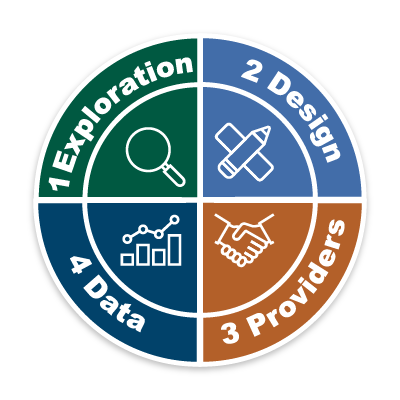
The Food and Nutrition Act of 2008, as amended, requires that every state operate a SNAP E&T program, which is defined as case management and one or more components. However, there is much more to operating an effective SNAP E&T program. The series overview gives a roadmap for state agencies as they consider growing and strengthening their SNAP E&T programs. States should use these resources to bolster the quality of their SNAP E&T program and improve SNAP participants’ ability to gain and retain employment. The series is made up of four interconnected parts: exploration, design, providers, and data.

Exploring the Existing State SNAP E&T Program
Each year, it is important for state agencies to assess their SNAP E&T program to determine if it meets their mission and goals. As a part of the exploration phase, states should assess current E&T program offerings, determine the interests and needs of the target population, and consult with their state workforce board and employers to understand the labor market.
Resources
- Approaches to Understanding the SNAP E&T Target Population
- Consulting with the State Workforce Development Board

Designing a SNAP E&T Program
Designing a SNAP E&T program is not a one-time effort. States need to continually review and assess their SNAP E&T programs based on evolving community factors—including current labor market needs, provider availability, and service quality—and the target population’s interests and needs. When these don’t align, the program may need to be redesigned. Tools that look at program operations through the lens of a participant, such as the Road to Engagement, can help states understand how to approach redesigning the program to better meet the needs of participants.
Resources

Selecting Providers to Meet Program Needs
The quality of SNAP E&T providers is a major factor in the success of a SNAP E&T program. It is important to find providers that meet a program’s needs and have the capacity and ability to serve SNAP participants. State agencies should periodically review their range of providers to ensure they offer a variety of services to their target populations. Not all providers will be a good match for SNAP E&T or the state’s specific needs. Identifying providers that are a good fit takes time and requires a clear understanding of a program’s mission and participants’ needs.
Resources

Monitoring Programs and Using Data
Data collection is essential to assessing how a SNAP E&T program meets its goals. It also informs decisions about improvements and program changes. Having access to individual-level data in real or near-real time allows states to monitor if providers are operating programs as intended, effectively serving participants, and achieving expected outcomes. It also gives states the information they need to make immediate program changes when necessary and to identify gaps where longer-term program improvements are needed to best meet participant and employer needs.
Reviewing and analyzing data should be a continuous process that supports all the other parts of growing and strengthening SNAP E&T programs.
Resources
- Coming soon