



States use a mix of local, state, and federal funding to operate SNAP Employment and Training (E&T) programs to help SNAP participants gain skills, find work, and move toward self-sufficiency. States vary in how they design SNAP E&T programs and invest resources.
Fiscal management is the process of monitoring funds and adjusting operations, as needed, to maximize the use of available resources and ensure a program has enough money to accomplish its goals. Fiscal management is fundamental for state SNAP agencies to fully leverage SNAP E&T resources, strengthen partnerships, and serve participants more effectively.
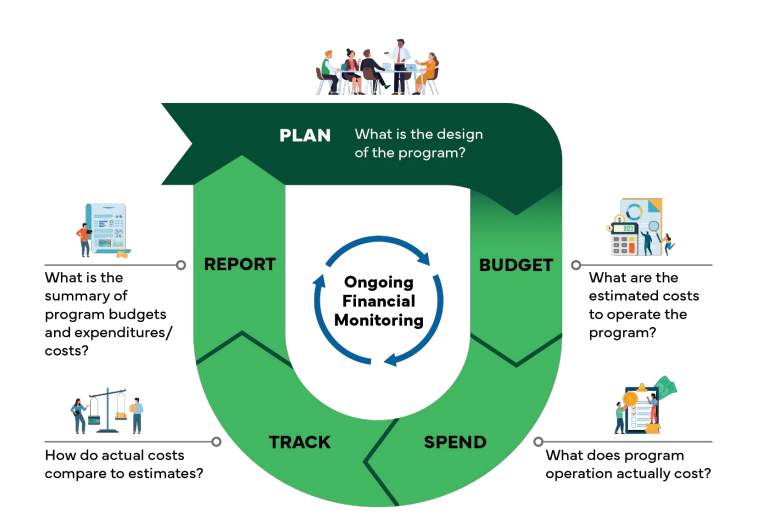
Strong SNAP E&T programs rely on coordination among program staff, budget and finance teams, contracts and procurement staff, data and reporting experts, and external partners. Clear communication and collaboration across these groups help programs run smoothly and improve over time. The resources below support a shared understanding of effective SNAP E&T fiscal management practices.
SNAP E&T Fiscal Management Toolkit
This SNAP E&T Fiscal Management Toolkit provides state agencies with a practical, end-to-end framework for managing program funds strategically, transparently, and in alignment with program goals. Grounded in federal requirements and informed by state operational realities, the toolkit emphasizes that strong fiscal management is essential to delivering effective SNAP E&T services that help participants build skills, secure employment, and expand pathways to greater economic mobility.
At the heart of the toolkit is the SNAP E&T fiscal lifecycle, a five stage framework that supports thoughtful, data‑driven financial management throughout the year: Plan, Budget, Spend, Track, and Report.
Additional Resources
Cost Allocation Tools
Cost allocation is essential for the budgeting and invoicing necessary to operate an effective and efficient SNAP E&T program that protects taxpayer resources. Find more resources to build effective SNAP E&T programs by accurately using SNAP E&T funds.
Planning and Budgeting Tools
The SNAP E&T Planning and Budgeting tools help state agencies analyze recent fiscal data to inform planning and budgeting for their SNAP E&T programs. These tools are optional resources to develop realistic estimates of upcoming program costs.
Webinars
-
Strengthening State Management of the SNAP E&T Fiscal Lifecycle
Introduces the SNAP E&T fiscal lifecycle and provide an overview of its five phases—plan, budget, spend, track, and report.
-
Better Budgets through Data-Driven Planning and Fiscal Coordination
Highlights the importance of collaboration with state fiscal and program personnel and how to use recent financial data to accurately forecast program costs.
-
Proactive Financial Management in SNAP E&T to Accurately Allocate Costs
Demonstrates guiding principles and practices states can use to improve the fiscal oversight of SNAP E&T providers, with an emphasis on accurate cost allocation.