



USDA’s Food and Nutrition Administration (FNA) regularly collects information about the school meal programs and how they operate from the people who know best – the state agencies that oversee the programs in each state and territory and the school food authorities (SFAs) that manage the programs locally in one or more schools. This study collected information about seven topics of interest in school year (SY) 2022-23: school meal preparation and service, household applications for free and reduced-price school meals, meal prices, unpaid meal charges, additional funding sources available to SFAs, the USDA Fresh Fruit and Vegetable Program, and use of the Fiscal Action Flexibility for Meal Pattern Violations waiver. The key findings for these topics are presented below. You may download the research briefs to learn more about each topic or navigate to other studies in the series.
Topic 1: School Meal Preparation and Service
- The top sources of standardized recipes for most SFAs were the USDA, in-house recipes, and the Institute of Child Nutrition.
- SFAs asked for more training and resources about how recipes credit toward meal pattern requirements, developing seasonal menus, and other topics.
- More than 70% of SFAs used scratch cooking and/or speed-scratch cooking at breakfast, lunch, or both meals. SFAs tended to use a combination of these methods at both meals.
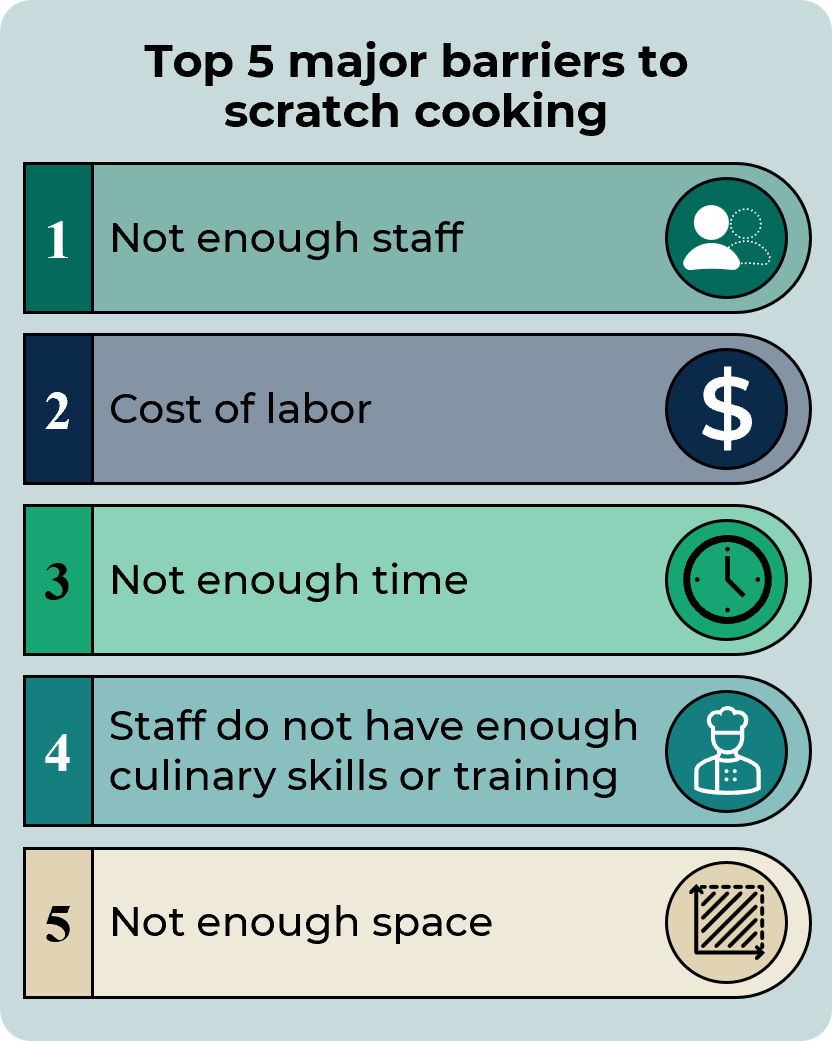
- SFAs that did not use scratch or speed-scratch cooking cited several barriers to doing so, including the cost of labor and not having enough staff or time.
- At least once per week, 43% of SFAs offered a breakfast menu and 27% offered a lunch menu that did not include animal-based proteins.
- SFAs experienced a variety of challenges in making meal accommodations for students with disabilities, especially with substituting meal or food components and obtaining the necessary medical statements.
Topic 2: Household Applications for Free and Reduced-Price School Meals
- Three-quarters of SFAs collected household applications to determine children’s eligibility for free and reduced-price school meals.
- About half of SFAs used paper applications more than other formats, and one-third of SFAs used electronic or web-based applications more than other formats.
- SFAs in states with universal free school meal policies were less likely to collect household applications than SFAs in states without such policies.
Topic 3: Meal Prices
- In states that did not offer universal free school meals, 65% of SFAs had one or more schools that charged students for school meals.
- The average price of a paid breakfast was $1.80.
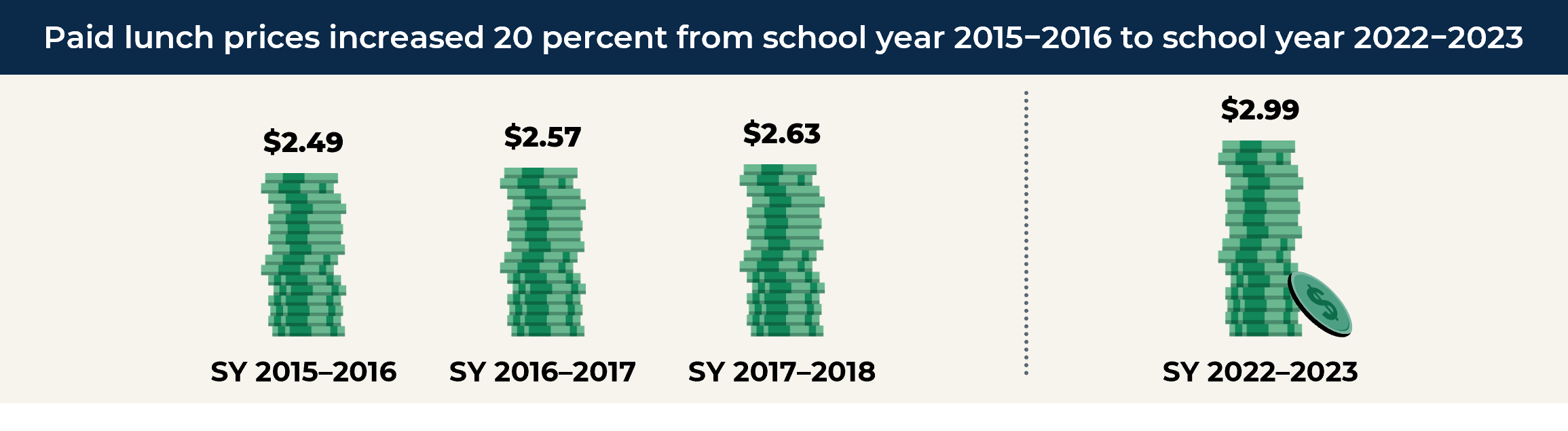
- · The average price of a paid lunch was $2.99, a 20% increase from the average price of $2.49 in SY 2015–16.
- In SY 2022-23, 24% of SFAs increased prices for paid lunches in their schools in response to the Paid Lunch Equity requirement of the Richard B. Russell National School Lunch Act.
Topic 4: Unpaid Meal Charges
- SFAs that charged students for school meals in SY 2022–23 tended to have local policies on meal charges instead of state policies.
- SFAs recovered about half of the money they were owed for unpaid meals.
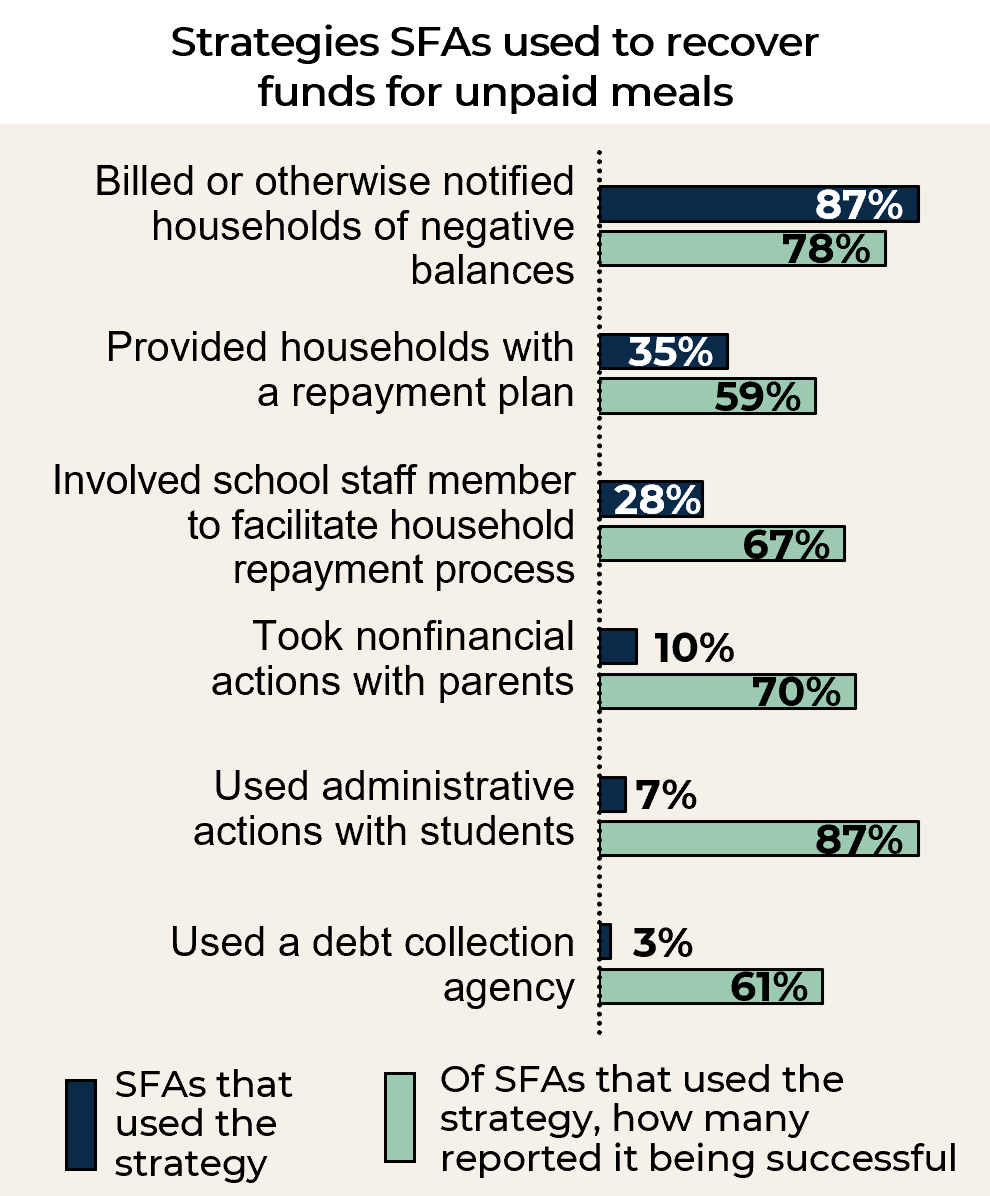
- The most commonly used strategy for recovering funds, which was also one of the most successful, was billing households or otherwise notifying them about negative balances.
Topic 5: Additional Funding Sources Available to SFAs
- In SY 2022–23, SFAs had access to federal funding to help offset high program costs due to the supply chain disruptions that persisted during that period.
- Most SFAs reported that their finances improved with the additional per-meal reimbursements provided through the Keep Kids Fed Act of 2022.
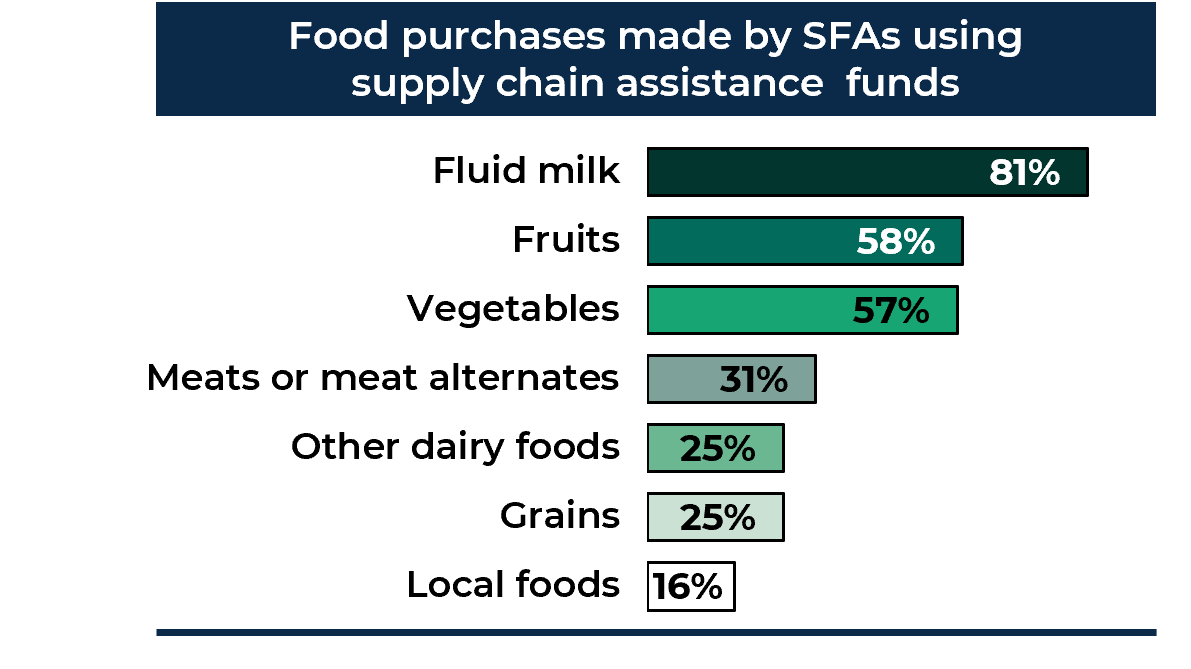
- Most SFAs received Supply Chain Assistance Funds, and the funds were most commonly used to purchase fluid milk, vegetables, and fruits.
- Most of the SFAs that received Equipment Assistance Grants from USDA used the funding to replace aging or broken equipment.
- About half of state agencies provided a subsidy for breakfasts or lunches. The most common was a per-meal reimbursement based on the number of reduced-price meals. About one-third of state agencies provided this type of subsidy.
Topic 6: USDA Fresh Fruit and Vegetable Program (FFVP)
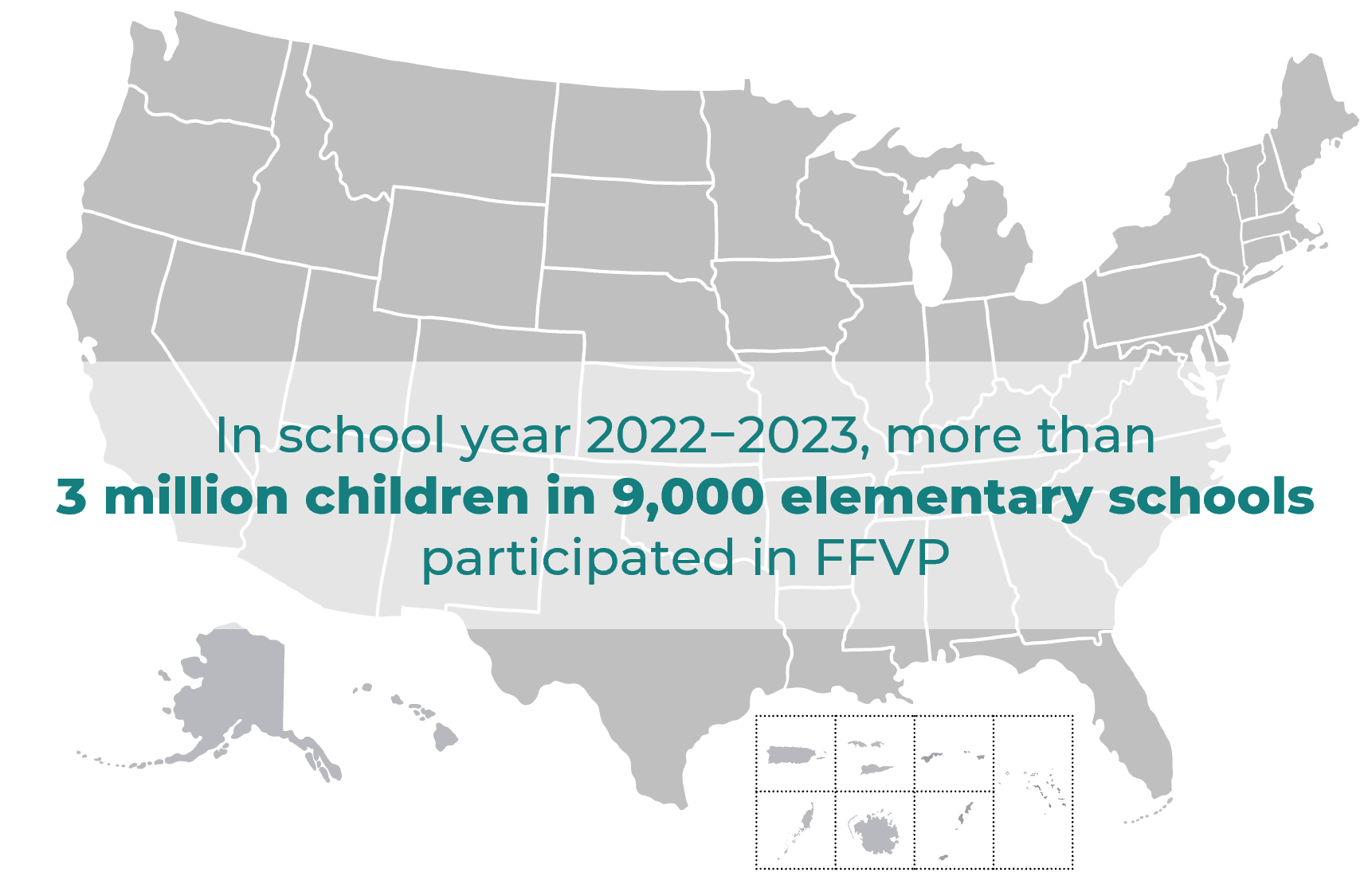
- In SY 2022–23, more than 3 million students in 9,000 elementary schools nationwide participated in FFVP.
- Nearly all state agencies that returned unused FFVP funding did so because schools did not use all the funding awarded to them during the school year.
Topic 7: Use of the Fiscal Action Flexibility for Meal Pattern Violations Waiver
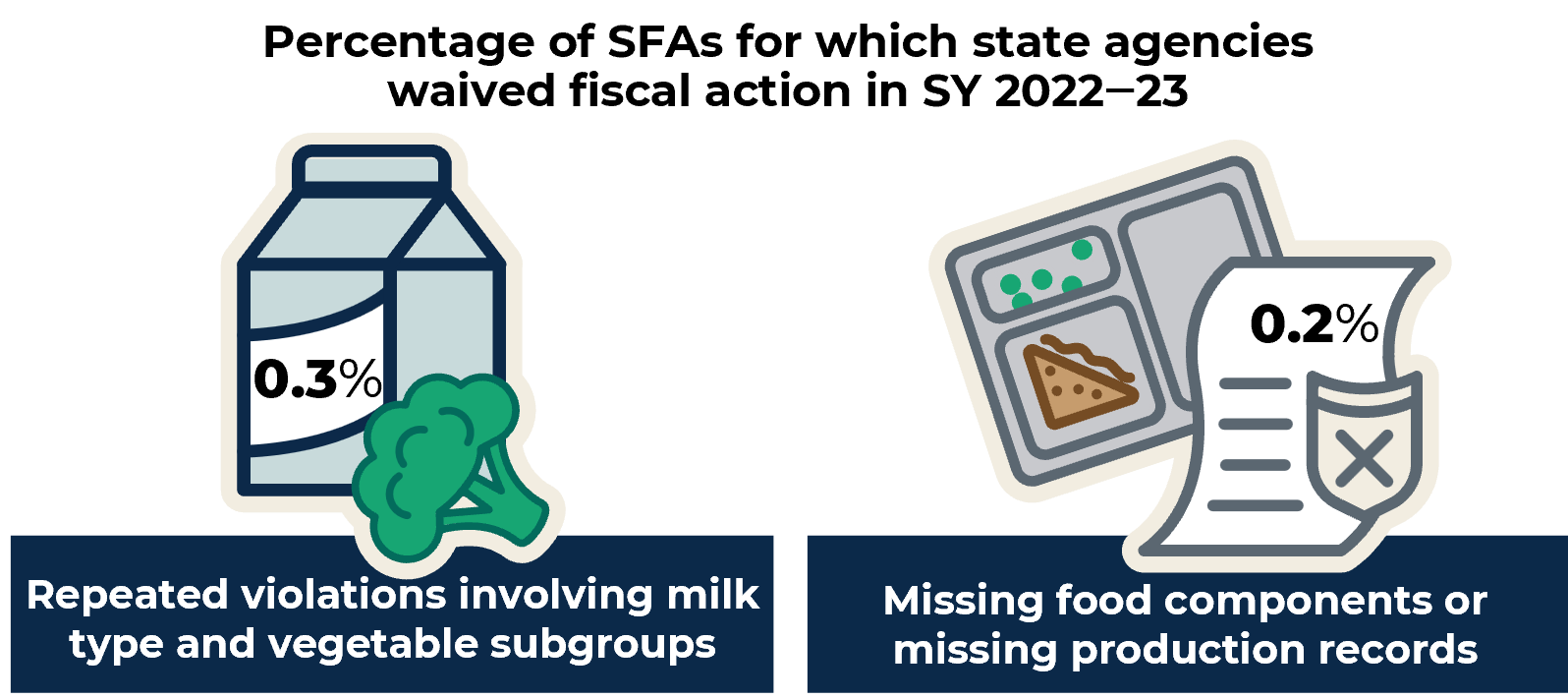
The USDA requires SFAs to offer meals with certain food groups and subgroups. The USDA also requires state agencies to take fiscal action against SFAs for meal pattern violations, which means that SFAs must recover funds for the unallowable meals. The COVID-19 pandemic caused supply chain issues that made it difficult for SFAs to consistently meet every meal pattern requirement, so the USDA allowed state agencies to waive fiscal action for some meal pattern violations. In school year 2022–23, 16 state agencies used the Fiscal Action Flexibility for Meal Pattern Violations waiver to waive fiscal action for less than 1% of SFAs nationwide.
Why We Did This Study
This study is part of the School Meal Program Operations study series and had two main purposes:
- To collect information required by the Families First Coronavirus Response Act (FFCRA), and
- To help us understand school meal program operations during school year 2022-23.
FFCRA required state agencies to report which waivers they used and how they improved services to children. Through this study, state agencies met their FFCRA reporting requirement and helped us understand school meal program operations during the fourth school year of the pandemic. The federal COVID-19 public health emergency declaration ended May 11, 2023.
How We Did This Study
The study team collected survey data about school meal program operations in school year 2022-23 from two important groups:
- The 56 state agencies that oversee the school meal programs (the National School Lunch Program and School Breakfast Program) in the U.S. states and territories, and
- A nationally representative group of 1,100 SFAs that manage the school meal programs locally in one or more schools.
The surveys collected information about seven topics of interest in school year 2022-23: the USDA FFVP, household applications for free and reduced-price school meals, meal prices, unpaid meal charges, additional funding sources available to SFAs, school meal preparation and service, and use of the Fiscal Action Flexibility for Meal Pattern Violations waiver.
- Yearly assessments help us ensure that the child nutrition programs are effective. Program assessments are so important they’re written into law - see part §1769i of the National School Lunch Act.
- Federal agencies must comply with the Paperwork Reduction Act. Before collecting data from the public, we publish the data collection plans and asks the public for comments. You can read the Information Collection Request and 60-day and 30-day requests for public comments.
Programs This Study Evaluates
Suggested Citation
Food and Nutrition Administration, Office of Evidence, Analysis, and Regulatory Affairs, USDA (2026). School Meal Program Operations in School Year 2022-2023. USDA Food and Nutrition Administration, Office of Evidence, Analysis, and Regulatory Affairs. Dataset. https://doi.org/10.15482/USDA.ADC/32781699