



This report, the latest in an annual series, presents 2023 national and state-level estimates of the number of people eligible to receive benefits provided through the Special Supplemental Nutrition Program for Women, Infants, and Children (WIC) and the percentage of the eligible population and the general U.S. population participating in the program.
The number of people eligible for WIC in 2023 remained about the same as the year prior.
- The estimated average monthly WIC-eligible population totaled 11.83 million in calendar year (CY) 2023 (Table 1), essentially unchanged from the estimate of 11.79 million in 2022.
- In 2023, about half of infants and children and more than one third of pregnant women in the U.S. were eligible to participate in WIC.
| Participant Category | Number Eligible | Percent of Total Eligible (%) | Total Population | Eligibility Rate (%) |
|---|---|---|---|---|
| Infants | 1,796,821 | 15.2 | 3,600,389 | 49.9 |
| Children | 7,626,138 | 64.5 | 14,713,756 | 51.8 |
| 1-year-old children | 1,883,018 | 15.9 | 3,672,400 | 51.3 |
| 2-year-old children | 1,914,319 | 16.2 | 3,668,357 | 52.2 |
| 3-year-old children | 1,937,138 | 16.4 | 3,619,422 | 53.5 |
| 4-year-old children | 1,891,664 | 16.0 | 3,753,577 | 50.4 |
| Women | 2,406,255 | 20.3 | 6,615,976 | 36.4 |
| Pregnant women | 1,091,474 | 9.2 | 2,791,608 | 39.1 |
| Postpartum women | 1,314,781 | 11.1 | 3,824,368 | 34.4 |
| Breastfeeding women | 848,829 | 7.2 | 1,995,462 | 42.5 |
| Non-breastfeeding women | 465,952 | 3.9 | 1,828,907 | 25.5 |
| Total | 11,829,215 | 100.0 | 24,930,121 | 47.4 |
In 2023, WIC reached 56% of those who are eligible – the highest coverage rate since 2016.
- The percentage of the eligible population participating in WIC is known as the coverage rate.
- In an average month in 2023, WIC served an estimated 56.1% of those eligible for WIC (Table 2), up from the estimate for 2022 (53.5%), and the highest coverage rate since 2016.
- The increase in the coverage rate resulted from the negligible change in the number of individuals eligible for WIC combined with a significant increase in participation. WIC participation increased by around 320,000 in CY 2023, an increase of about 5% over the year prior.
| Characteristic | Number Eligible | Number Participating | Coverage Rate (%) |
|---|---|---|---|
| Total | 11,829,215 | 6,631,309 | 56.1 |
| Participant Category | |||
| Infants | 1,796,821 | 1,479,155 | 82.3 |
| Children | 7,626,138 | 3,656,078 | 47.9 |
| 1-year-old children | 1,883,018 | 1,268,459 | 67.4 |
| 2-year-old children | 1,914,319 | 1,004,346 | 52.5 |
| 3-year-old children | 1,937,138 | 874,822 | 45.2 |
| 4-year-old children | 1,891,664 | 508,450 | 26.9 |
| Pregnant women | 1,091,474 | 538,332 | 49.3 |
| Postpartum women | 1,314,781 | 957,744 | 72.8 |
| Breastfeeding women | 848,829 | 600,628 | 70.8 |
| Non-breastfeeding women | 465,952 | 357,117 | 76.6 |
| Race and Hispanic Ethnicitya | |||
| Hispanic/Latino | 4,341,509 | 2,865,239 | 66.0 |
| Black-only, not Hispanic | 2,477,494 | 1,308,652 | 52.8 |
| White-only, not Hispanic | 3,742,399 | 1,840,027 | 49.2 |
| Two or more races or other race, not Hispanic | 1,238,566 | 602,318 | 48.6 |
| American Indian/Alaska Native, not Hispanic | 243,653 | 112,539 | 46.2 |
| Asian, not Hispanic | 619,026 | 285,804 | 46.2 |
| Native Hawaiian/Pacific Islander, not Hispanic | 74,125 | 46,583 | 62.8 |
a See report “Table 3.1 WIC coverage rate by participant characteristics” for detailed definitions of race and ethnicity categories used in the report.
Coverage rates varied by participant category and characteristics – continuing to be highest for infants and decreasing as children age.
- In 2023, coverage rates were highest for WIC-eligible infants (82.3%) and postpartum non-breastfeeding women (76.6%), while the coverage rates for WIC-eligible children (47.9%) and pregnant women (49.3%) continued to be lower than other participant categories.
- The relative differences in coverage rates by participant category remained mostly consistent from CY 2005 to CY 2023. Across all years, coverage rates were highest for infants, followed by coverage rates for postpartum women. Coverage rates for children were consistently the lowest (except for 2022, when the coverage rate for pregnant women was the lowest).
- In recent years, coverage rates for pregnant women have declined more rapidly than for other participant categories, declining from 53.0% in 2018 to 49.3% in 2023, despite a small increase in coverage rates for pregnant women between 2021 and 2023.
- The estimated coverage rate for WIC-eligible individuals in metropolitan areas in the average month of 2023 was 61.1%, while the coverage rate for WIC-eligible individuals in nonmetropolitan areas was 24.0%. Of the 11.83 million individuals eligible for WIC, an estimated 10.21 million lived in metropolitan areas in 2023.
A large share of Medicaid and SNAP participants do not participate in WIC despite being eligible.
- Consistent with previous findings, large percentages of Medicaid and Supplemental Nutrition Assistance Program (SNAP) recipients who were eligible for WIC did not participate in WIC in 2023.
- Among WIC-eligible Medicaid participants, 32.0% participated in WIC.
- Among WIC-eligible SNAP participants, 57.6% participated in WIC.
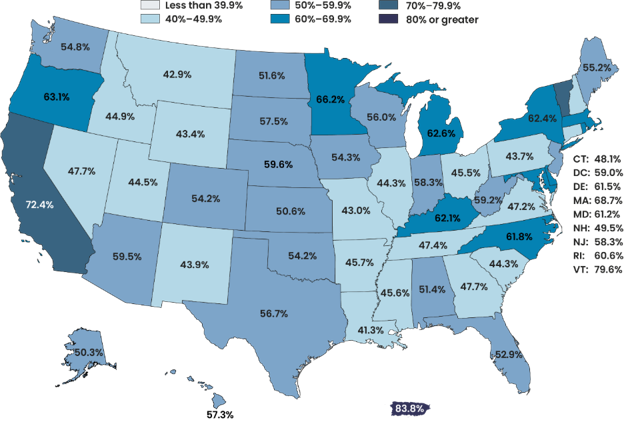
Coverage rates vary substantially by state.
- Coverage rates vary substantially by state, as shown in the map below (Figure 1), ranging from around 40% in some states to more than 70% in others.
- Coverage estimates are less precise for states with small populations compared to other states (see Figure 3.5 in the full report); therefore, differences between states and across years may be less pronounced than they appear in the map.
Why FNA Did This Study
WIC provides healthy foods, breastfeeding support, nutrition education, and referrals to other services to eligible pregnant, breastfeeding and non-breastfeeding (up to six months after the end of pregnancy) postpartum women, infants, and children up to age 5.
WIC funding is provided by Congress through the annual appropriations process. Since approximately 1997, Congress has funded WIC at a level sufficient for the program to serve all eligible applicants. WIC funding needs are estimated annually using the number of individuals eligible for WIC and the percentage of the eligible population likely to participate. We allocate funds to participating state agencies based on a formula that considers the previous year’s funding and the estimated eligible population in each WIC state agency, along with other factors. Accurately estimating the number of individuals eligible for WIC and the number likely to participate enables us to better predict future funding needs, measure WIC performance, and identify potentially unmet nutrition assistance needs.
This report presents estimates of the numbers of women, infants, and children eligible for WIC during an average month in 2023 and historical estimates for 2016–2022. This is the most recent report in a series that provides eligibility estimates at the national, regional, and state levels. Estimates are also provided by participant category—infants, children, pregnant women, and postpartum women—and by race and ethnicity, urbanicity, and reported household income.
How FNA Did This Study
We calculated the estimates for this study on a methodology developed in 2003 by the Committee on National Statistics of the National Research Council.1 The 2023 estimates continue to incorporate methodological improvements first described in the 2021 report.2 These methodologies use data from various sources, including the Community Population Survey Annual Social and Economic Supplement (CPS-ASEC), American Community Survey (ACS), and National Vital Statistics. The estimates presented in this report use the same methodology as and are consistent with the 2022 WIC eligibility estimates published in 2024.3
1 Ver Ploeg, M., & Betson, D. M. (Eds.). (2003). Estimating eligibility and participation for the WIC program: Final report. The National Academies Press.
2 Kessler C., Bryant A., Munkacsy, K., and Gray K. (2023). National- and State-Level Estimates of WIC Eligibility and WIC Program Reach in 2021. Prepared by Insight Policy Research, Contract No 12319819A0005. Alexandria, VA: U.S. Department of Agriculture, Food and Nutrition Administration, Office of Policy Support, Project Officer: Grant Lovellette. Available online at: https://www.fna.usda.gov/research/wic/eer/2021.
3 Kessler C., Bryant A., Munkacsy, K., and Gray K. (2024). National- and State-Level Estimates of the Special Supplemental Nutrition Program for Women, Infants, and Children (WIC) Eligibility and WIC Program Reach in 2022. Prepared by Insight Policy Research, Contract No 12319819A0005. Alexandria, VA: U.S. Department of Agriculture, Food and Nutrition Administration, Office of Policy Support, Project Officer: Grant Lovellette. Available online at: https://www.fna.usda.gov/research/wic/eer/2022.
Suggested Citation
Kessler C., Bryant A., Munkacsy K., Maxson S., Ressler D., Saluja R., and Farson Gray K. (2025). National- and State-Level Estimates of the Special Supplemental Nutrition Program for Women, Infants, and Children (WIC) Eligibility and WIC Program Reach in 2023. Prepared by Westat, Contract No. GS-00F-009DA/140D0424A0040, Order No. 140D0424F1045. Alexandria, VA: U.S. Department of Agriculture, Food and Nutrition Administration, Project Officer: Grant Lovellette. Available online at: www.fna.usda.gov/research/wic/eer/2023.